The Italian market — the mercato, the outdoor food market that sets up weekly or daily in piazzas, under permanent canopies, and along the street edges of Italian towns and cities — is one of the most accessible and revealing entry points into Italian daily life. Unlike the museum, the market requires no admission fee and no advance booking; unlike the restaurant, it demands no specific occasion or formal commitment. It is simply there, on its appointed days and in its appointed place, serving the community that has been buying from it for generations, and the visitor who finds it and joins the flow of the morning shopping is immediately inside a version of Italian life that the tourist infrastructure does not stage.
The Italian market tradition is ancient and continuous: the weekly market in Italian towns predates the modern state, the modern economy, and in some cases the modern concept of commerce. The market day — mercoledì at one town, venerdì at the next — organises the agricultural week, with producers bringing their goods from the surrounding countryside to the town centre on the appointed day, and the population of the town making the market visit a social occasion as well as a practical one. This tradition has been modified by supermarkets, by the shift to urban employment, and by the decline of small-scale farming, but it has not been extinguished: the Italian market remains, in most towns and in many city neighbourhoods, a functioning institution that serves real people for real purposes.
The Food Market: A Seasonal Education
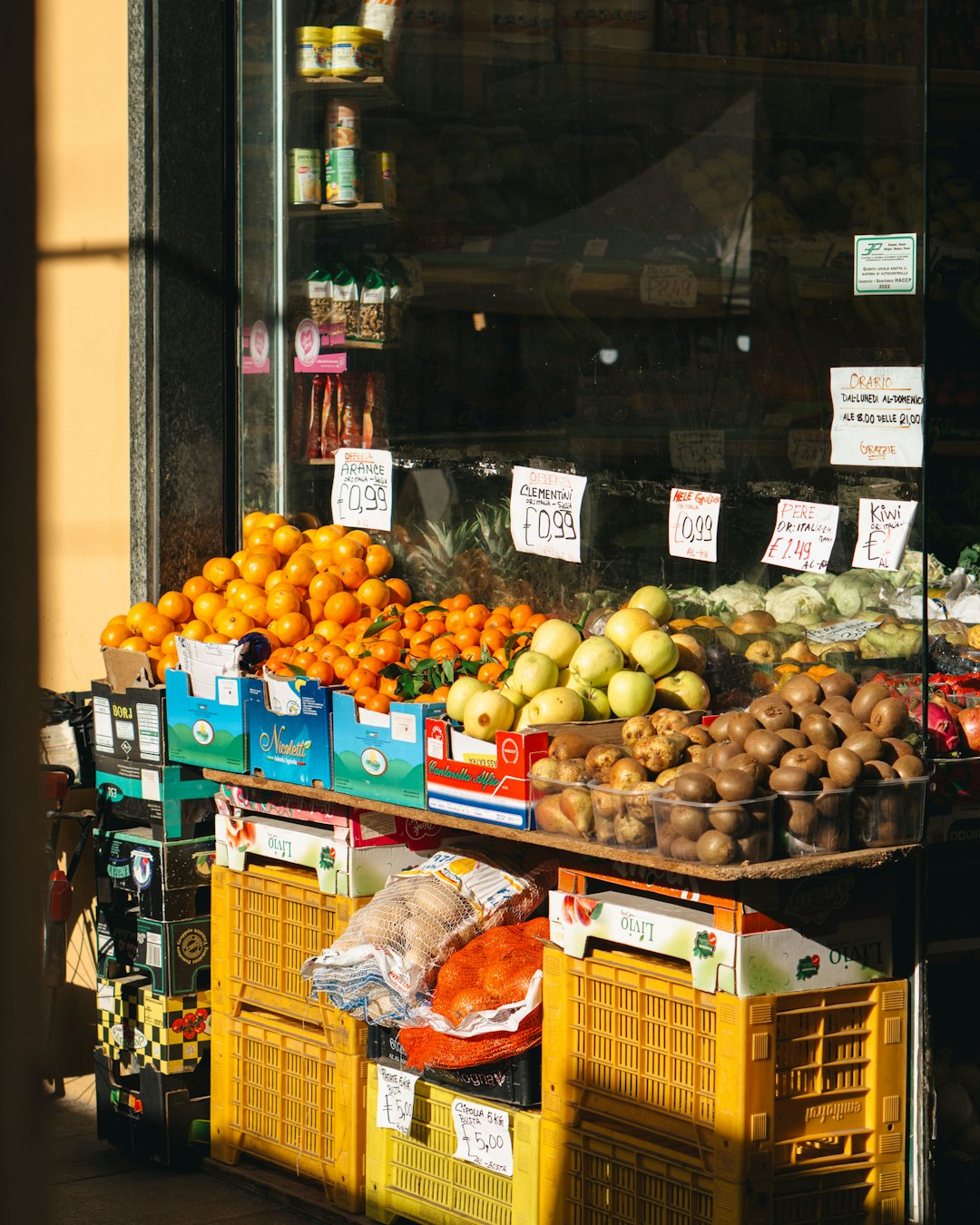
The food section of the Italian market is where the Italian relationship with seasonal eating is most visibly and immediately expressed. The stalls of a good Italian market in April look entirely different from the stalls of the same market in November — not because different vendors are present, but because the products on display are governed by what is actually growing in the surrounding countryside at that moment. The asparagus of the Veneto in April, the porcini mushrooms of the Apennines in September, the blood oranges of Sicily in January, the white truffles of Alba in October — these appear at the market when they are ready and in the quantities that the season has produced, and their presence or absence on the stalls is the most honest possible guide to what should be on the table that week.
The vendors at a good Italian food market have a level of product knowledge that the supermarket cannot replicate: the tomato seller who can tell you which variety is best for a raw salad and which is better cooked, the cheese vendor who has aged the pecorino himself and can cut a wedge at exactly the right point of maturation, the fishmonger who can explain whether the branzino came from the Adriatic this morning or from an aquaculture operation in Greece (the distinction matters, and the price difference reflects it). This knowledge, freely shared with customers who ask, is both useful and pleasurable — buying at the market is a conversation as well as a transaction.
The hierarchy of Italian food markets runs from the municipal daily market of a large city (the Sant’Ambrogio in Florence, the Campo de’ Fiori in Rome, the Porta Palazzo in Turin) to the weekly market of a small town (which may be excellent or merely functional depending on the quality of the local agricultural production) to the specialist market (the truffle market of Alba, the wine and cheese markets that accompany agricultural fairs throughout the year) to the farmers’ market (the mercato contadino, where producers sell directly from their own farm without intermediary). Each type has its specific qualities and its specific appeal.
The Great Italian Markets
The Porta Palazzo market in Turin is the largest outdoor market in Europe by surface area — approximately 50,000 square metres of market stalls in the Piazza della Repubblica, running every day except Sunday and encompassing food, clothing, household goods, and an extraordinary ethnic section that reflects Turin’s position as a post-war industrial city that received migration from southern Italy and, more recently, from North Africa and the Middle East. The food section of Porta Palazzo is a genuine working market for the Torinese population, not a tourist attraction: the prices are competitive, the quality variable, and the experience of navigating it is immersive in a way that the more famous Italian markets are not.
The Ballarò market in Palermo is perhaps the most atmospheric food market in Italy — a daily market in the working-class neighbourhood behind the Norman palace, where the fishmongers call the catch in Sicilian dialect, the vegetable sellers stack their wares in pyramids of colour, and the arancini and sfincione (Sicilian thick-crust pizza) are sold hot from temporary fry stands at the edges of the market. The Ballarò, alongside the Vucciria and the Capo, is one of the three historic markets of Palermo, all of them in the ancient Arab quarter of the city, all of them maintaining a continuity with the medieval souk tradition that is visible in their spatial organisation and in the merchant’s call that fills the air. The Ballarò is the most active and the most genuinely local of the three; the Vucciria has become more tourist-oriented; the Capo is a strong second for authenticity.
The Rialto market in Venice — the fish market (pescheria) and the vegetable market (erberia) on the San Polo side of the Rialto bridge — is among the most beautiful market settings in Italy, with the Gothic market loggia built in 1907 in a medieval style providing the backdrop for the daily morning fish trade. The quality of the fish at the Rialto is genuinely exceptional: the Adriatic fishing grounds that supply Venice produce a range of seafood (the granseola spider crab, the folpetti baby octopus, the cape sante scallops, the moeche soft-shell crabs available only in spring and autumn when the crabs are moulting) that the visitor who cooks will find difficult to resist. The market closes by early afternoon and is best in the morning.

The Clothing and Antiques Markets
Beyond food, the Italian market tradition encompasses a broad range of goods — clothing, household items, antiques, books, crafts, and the miscellaneous category of secondhand goods that the Italian market calls mercatino dell’usato (the “second-hand market”). The clothing sections of the large weekly markets (the Saturday market of San Giovanni in Rome, the Tuesday market of Porta Genova in Milan) offer an extraordinary range at prices that reflect the direct-from-manufacturer sourcing that Italian wholesale clothing markets have maintained since the garment industry’s heyday. The quality and authenticity vary — not everything at the Italian clothing market is Italian-made or Italian-brand — but the selection, the prices, and the atmosphere of the Italian outdoor clothing market have no equivalent in the retail landscape.
The antiques market is a separate and more specialised world. The Porta Portese in Rome — the Sunday flea market that runs along the Viale Trastevere and into the surrounding streets — is the most celebrated Italian flea market and one of the largest in Europe, with an estimated 4,000 stalls on a normal Sunday morning. The range at Porta Portese encompasses genuine antiques (furniture, ceramics, silverware, religious art), vintage clothing and accessories, secondhand books, tools, and a large section of contemporary secondhand goods that borders on the purely practical. Navigating Porta Portese requires patience, early arrival (the best finds are gone by nine in the morning), and the willingness to examine closely what is on offer — not everything presented as antique is so, and the skills of the antique market — assessing age, provenance, and condition at a glance — take time to develop.
The Fiera di Sinigallia in Milan — the Saturday flea market along the Alzaia Naviglio Grande — is the Milanese equivalent of Porta Portese, smaller and more curated, with a higher proportion of genuinely antique material and a clientele that includes both serious collectors and casual browsers. The quality of the vintage clothing and accessories at Sinigallia reflects Milan’s fashion industry heritage; the furniture and ceramics reflect the quality of Lombard decorative arts production over the past two centuries.
The Farmers’ Market and the Slow Food Connection
The farmers’ market (mercato contadino or mercato dei produttori) is a more recent innovation in the Italian market landscape, driven by the Slow Food movement and by the growing urban interest in direct relationships with food producers. Unlike the traditional Italian market — where vendors may be wholesalers as often as producers — the farmers’ market requires participants to be the producers of the goods they sell: the vegetable grower who sells their own vegetables, the cheese maker who sells their own cheese, the artisan baker who bakes the bread they are selling. This direct relationship between producer and consumer creates a different kind of market interaction and, typically, a higher quality of product, since the producer knows their goods in a way that a reseller does not.
The Slow Food Earth Markets network, which certifies producers’ markets across Italy according to the principle of direct producer-consumer relationships, provides a useful guide to finding genuine farmers’ markets in Italian cities and towns. Turin’s Eataly and the Slow Food markets around the city are among the most developed examples; the Campagna Amica markets (organised by Coldiretti, the Italian agricultural federation) operate in most major Italian cities on weekend mornings and offer direct-from-farm produce at prices that are often competitive with the conventional market.

Practical Notes for Market Shopping
The Italian market is a morning institution: most food markets are at their best between eight and eleven, and some close by noon or one in the afternoon. Arriving early — before ten — is advisable at any market where the best produce is likely to be taken quickly. The market day varies by location: checking the specific day for the market you want to visit is essential, as most weekly markets operate one or two days per week only.
The etiquette of the Italian food market follows simple rules. Do not handle the produce at vegetable and fruit stalls without asking — the vendemmia (vendor) will select the produce for you, and this is not just custom but good practice, since they know their stock. Carry a shopping bag or basket, as Italian food market vendors do not reliably provide bags. Bring cash, as many vendors do not have card payment facilities. And be prepared to browse before buying — the first pass through the market is the reconnaissance pass, where prices are noted and the range of what is available is assessed, before the buying pass, where purchases are made.
The most important thing the visitor can bring to an Italian market is time. The market is not a place to rush through with a shopping list and return quickly to a schedule. It is a place to look, to engage, to taste when tastings are offered, to exchange a few words with the people selling and buying, and to allow the experience of the market — its sounds, its smells, its visual variety, and its social textures — to constitute a morning’s experience in itself. This is how Italians use their markets, and this is how the visitor will understand them most fully.