The experience most visitors have of Venice is a journey from one compressed spectacle to the next: the arrival at Santa Lucia station, the canal crossing by vaporetto, the walk through the alleys toward San Marco, the basilica, the Doge’s Palace, the Rialto, and then, for the majority, the reverse journey back to the mainland on the same day or the following morning. This itinerary delivers what Venice’s global reputation has been built on. It also manages, in the process, to exclude almost entirely what makes the Venetian lagoon one of the most complex and interesting bodies of water in the world.
The lagoon is not an approach to Venice. It is the thing itself — a shallow, living ecosystem of approximately 550 square kilometres, enclosed by narrow barrier islands from the Adriatic, threaded with channels marked by wooden stakes, dotted with islands that range from uninhabited mudflats to small communities with continuous histories stretching back to the late Roman period. The major islands are known by name to anyone who has done the tourist circuit — Murano for glass, Burano for lace and coloured houses, Torcello for the mosaic basilica. What is less known is the texture of a lagoon that contains, within the scope of a day’s travel by small boat, a range of landscapes, histories, and atmospheres that the main island of Venice, for all its extraordinary qualities, cannot contain within itself.
Murano: Beyond the Glass Factories
Murano is the most visited of the lagoon islands after Venice itself, and the visit most tourists make — the organised transfer by boat to a glass factory, the demonstration of glassblowing, the showroom, the transfer back — is not the visit worth making. What Murano actually is, for those who arrive without a manufactured programme, is a small island with its own character distinct from Venice: quieter, with a working-class permanence that the main island has largely lost to tourism and second-home conversion, and with architectural and historical interest beyond the glass production.
The glassmaking has been practised here since 1291, when the Venetian Republic relocated the furnaces from the main island on fire safety grounds — and in so doing created a community of craftspeople whose techniques were protected as state secrets and whose products were traded across the known world. The best of that tradition is still active in workshops where the skill has been passed through families over many generations, and where the production is not primarily tourist demonstration but actual design and manufacturing. The difference between a glass object made by a master whose family has worked this material for a century and a tourist-grade piece from a factory showroom is visible and significant. Finding the former requires asking locally and walking to workshops that are not on the main tourist route.
The Basilica dei Santi Maria e Donato in Murano is one of the finest examples of Venetian-Byzantine architecture in the lagoon, containing 12th-century floor mosaics that rival those of Torcello and a collection of relics whose provenance tells a story of Venetian mercantile expansion across the Mediterranean. It is visited by a fraction of the people who pass through the island on glass factory tours.
Burano: More Than Coloured Houses
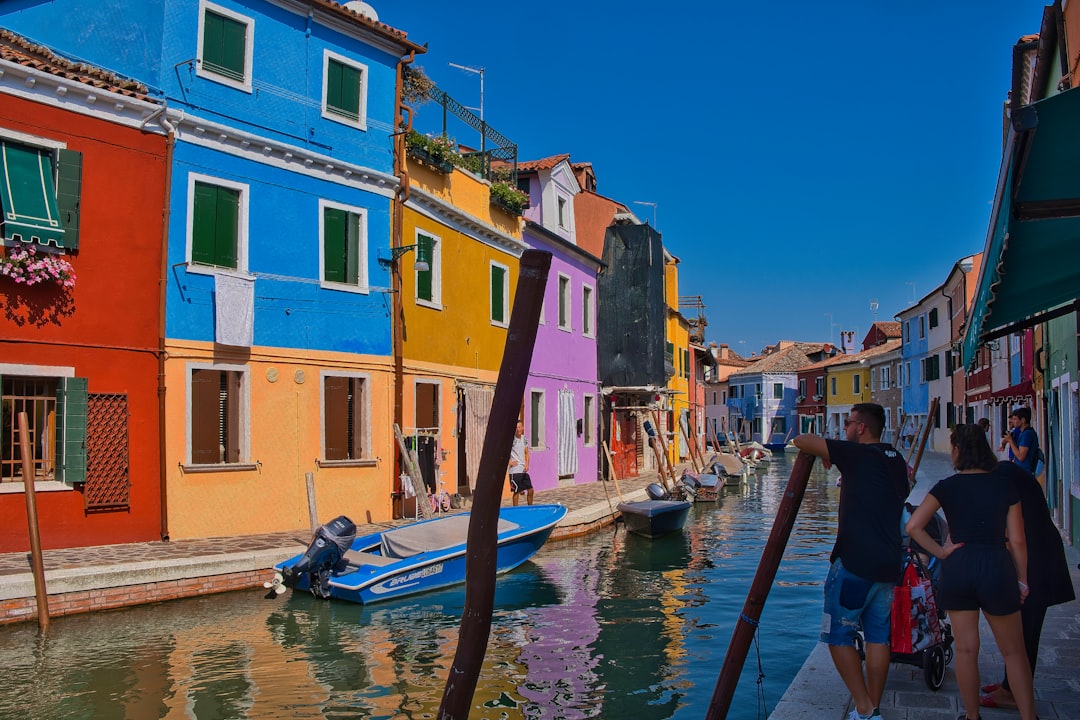
Burano’s painted house facades have made it one of the most photographed places in the Venetian lagoon, and the colours — applied according to a system of permits that controls which houses can be painted which colours — are genuinely striking in the quality of light that northern Adriatic mornings provide. The photographic potential of the island’s canals is real and has been exhaustively documented. What this documentation tends to omit is that Burano is also the most genuinely inhabited of the larger lagoon islands — a community of fishing families and lacemakers where daily life has a rhythm and texture that the main island of Venice has lost to tourist monoculture.

The lacemaking tradition here is ancient — Burano lace was a significant luxury export of the Venetian economy from the 16th century onward — and the lace museum on the island documents the technique and its history with a thoroughness that the tourist trade in lace souvenirs (most of which are not produced locally) tends to obscure. Authentic Burano lace — punto in aria, made entirely by hand with needle and thread — takes hundreds of hours to produce even a small piece and costs accordingly. The handful of craftswomen still practising at the highest level are elderly, and the survival of the tradition into the next generation is genuinely uncertain.
The fish restaurants of Burano have a reputation among Venetian food people as among the best in the lagoon for seafood cooked simply and well. The catch — from the lagoon and from the Adriatic beyond — arrives directly, and the preparation reflects a tradition of using everything the sea provides rather than selecting for the few species that tourism has made familiar. Expect to spend €35-55 per person for a full fish lunch with wine at a serious establishment. The prices reflect the quality of the ingredients and the proximity to the source.
Torcello: Where Venice Began
Torcello is the most historically significant of the lagoon islands and also, paradoxically, the most sparsely inhabited. The island was one of the first major settlements in the lagoon — established by refugees from the mainland Roman cities fleeing Lombard invasions in the 6th and 7th centuries — and at its medieval peak may have housed a population of 20,000 or more. The silt accumulation that gradually made the island’s channels impassable, combined with the malaria that accompanied the resulting marshes, drove the population away over several centuries until the island was reduced to the small community that exists today.
What the abandonment preserved is extraordinary: the Basilica di Santa Maria Assunta, built in the 7th century and rebuilt in subsequent centuries, contains Byzantine mosaics that belong among the finest examples of the medium anywhere in Europe. The apse mosaic — the gold-ground Virgin and Child against an abstract gold background — has the quality of direct communication across fourteen centuries that the best Byzantine art achieves. The west wall Last Judgement, enormous and densely populated with figures, tells the entire arc of Christian cosmology in visual terms that still carry their medieval power. The basilica receives far fewer visitors than the museums of Venice, and it is possible, outside of peak summer, to stand in front of these works in something approaching the silence they warrant.
The Smaller Islands: Beyond the Circuit
The lagoon contains islands beyond the famous three that most visitors never reach, and several of them repay the effort of getting there significantly. Sant’Erasmo is the garden of Venice — a flat, sandy island traditionally devoted to vegetable cultivation, supplying artichokes, asparagus, and other produce to the Rialto market. The island is accessible by vaporetto and feels, in its quiet and its agricultural character, entirely unlike anything else in the lagoon. The artichoke season in spring draws Venetian food people for the violet-tinged variety grown here that has no equivalent elsewhere.

Mazzorbo, connected to Burano by a footbridge, is primarily residential and agricultural — its restored vineyard produces a white wine from the ancient Dorona variety that was almost lost before recent restoration efforts. The wine from this vineyard is sold in small quantities to Venetian restaurants and represents one of the more unlikely connections between the lagoon’s agricultural past and its present.
La Certosa is an island between the main city and the Lido that has been converted from a former monastery and military facility into a sailing centre and park. It is accessible by water taxi and provides one of the very few points in the lagoon where it is possible to walk through open green space within sight of Venice’s skyline. For visitors who need relief from the density of the main island without leaving the lagoon, it provides a different kind of spatial experience.
Getting Around the Lagoon
The public vaporetto system covers the main islands with reasonable frequency and runs on schedules that are available in the ACTV app and at the ticket kiosks. Single journeys and multi-day passes provide the most economical way to move between the larger islands. Private water taxis are expensive but efficient for specific trips or group travel. Small boat rentals — some requiring a boat licence, others available without — allow for independent navigation of the lagoon’s secondary channels in ways that the vaporetto circuit cannot provide.
The rhythm of a lagoon day is different from a Venice city day: distances are greater, the pace is slower, the connection between different islands depends on the vaporetto schedule or the willingness to pay for private transport. Building a day around the lagoon — arriving at Torcello early, walking to the basilica before the tour groups arrive from Venice, continuing to Burano for lunch, then back via Murano in the afternoon — produces an experience that is more physically comfortable, more historically layered, and more genuinely varied than another day on the main island’s well-worn paths.
The Lagoon as System
The most important thing to understand about the Venetian lagoon is that it is not a series of separate destinations but a single living system — biological, historical, and human — in which the individual islands are nodes rather than the whole. The water itself, moving with tides that still shape the rhythm of daily life despite the MOSE flood barriers that now manage the worst of the acqua alta, carries nutrients, boats, and the particular light that has made Venetian painting what it is. The fishermen working the channels, the birds on the uninhabited mudflats, the vegetable gardens on Sant’Erasmo, the glass furnaces on Murano, and the Byzantine mosaics on Torcello are all part of the same system that produced Venice — not the famous city as background to a tourist experience, but the full and extraordinary thing itself.