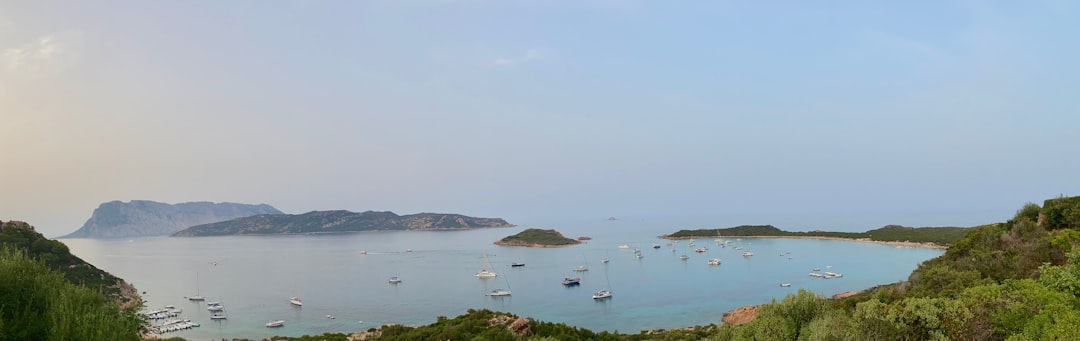
Sardinia’s wild Sardinian coast has long occupied the imagination of European travellers — the Costa Smeralda, the beaches of the Sulcis, the granite cliffs of Ogliastra. The interior is something else entirely: a landscape of granite massifs, cork oak forest, ancient stone towers, and villages where the relationship with the outside world has been, historically, one of cautious negotiation rather than ready exchange. The Barbagia, the mountain heartland of the island occupying the central-eastern interior, is the part of Sardinia that has most completely preserved a culture, a language (Sardo, a Romance language distinct from Italian and substantially unintelligible to Italian speakers), and a set of social practices that constitute one of the more distinctive surviving expressions of a pre-modern Mediterranean world.
This is not a romantic description in the sense of being unreliable or sentimental. It is an observation about what happens when a mountain people with a history of resisting outside authority — Carthaginian, Roman, Aragonese, Piedmontese — maintains that resistance long enough to preserve cultural forms that elsewhere were absorbed, diluted, or replaced. The Barbagia is not the interior of Tuscany, where the hills have been cultivated and documented for a thousand years and where every valley is threaded with roads and marked with signage. It is somewhere that has been largely left to its own logic, and visiting it requires engaging with that logic rather than expecting the landscape to perform according to external tourist conventions.

The Nuraghi: An Ancient Civilization in Stone
Before engaging with the living culture of the Sardinian interior, a visitor should understand the landscape’s oldest visible layer: the nuraghi. These Bronze Age stone towers — there are approximately 7,000 surviving examples on the island, making Sardinia the most nuraghe-dense place on earth — were built between roughly 1800 and 800 BCE by the Nuragic civilization, a culture whose sophistication and geographic extent is still being revealed by ongoing excavation. The nuraghe themselves are defensive and residential structures: truncated cones of perfectly fitted dry stone, reaching heights of 15-20 metres, with corbel-vaulted internal chambers and, in the more complex examples, surrounding villages of circular stone huts.
The most impressive single nuraghe complex in Sardinia — Su Nuraxi di Barumini, in the province of Medio Campidano — is a UNESCO World Heritage Site and gives the most complete picture of what a developed nuragic settlement looked like. But the nuraghi of the interior landscape are more widely distributed and often encountered in agricultural land, on hillsides above villages, and in positions that give them natural defensive advantage over the surrounding terrain. Finding one alone in a cork oak forest, without explanatory signage or guided tour, produces a more direct encounter with the scale of what the Nuragic civilization achieved than the more organized heritage sites provide.
The Barbagia: Life at Altitude
Orgosolo is the town most associated internationally with the Barbagia — primarily through the murals painted on its walls since the 1960s, which began as political statements and evolved into a comprehensive visual record of the town’s social history, agricultural life, and relationship with the outside world. The murals now cover hundreds of buildings and constitute one of the largest collections of politically engaged public art in Italy. Walking through Orgosolo with sufficient time to read them is an experience that belongs to art history, social history, and cultural anthropology simultaneously.
Oliena, north of Orgosolo on the slopes of the Supramonte massif, is the base for access to some of the most spectacular mountain scenery in Sardinia: the Su Gologone spring, where the water from the internal karst system of the Supramonte emerges in sufficient quantities to form a river immediately, is a few kilometres from the town, and the walking routes into the gorges and limestone formations of the Supramonte above require a guide but reward the effort with a quality of landscape that is genuinely unusual even by Sardinian standards. The Gola di Gorropu — a limestone canyon that in places narrows to a few metres wide between walls that reach 500 metres — is reached by a four-hour walk from the valley floor and constitutes one of the most impressive natural features in the western Mediterranean.
The Shepherds and the Pastoral Economy
The shepherd culture of the Barbagia is not a heritage performance. It is a current economic and social reality, though one that is under the same demographic and economic pressure as pastoral systems throughout southern Europe. The pecorino cheese produced from the milk of the local Sarda sheep — in its various aged forms, from the fresh and mild to the hard, pungent, and suitable for grating that is closest to the mainland’s Pecorino Romano — is the product most directly connected to this shepherding tradition. Visiting a farm producer during the cheesemaking season (spring and early summer) and eating the fresh cheese with bread and the mirto liqueur made from the local myrtle berries is one of the more direct ways of engaging with the food culture that the landscape sustains.
The Festivals: When the Interior Opens
The Barbagia towns organise, each October and November, a coordinated series of open-house events called Autunno in Barbagia — in which the artisans, food producers, and cultural custodians of individual villages open their homes, workshops, and cellars to visitors. Each weekend features a different group of villages, and the events are attended by a mix of Sardinians from other parts of the island and visitors from mainland Italy and abroad. The combination of direct access to artisanal production — cork carving, wood working, weaving, knife making (the traditional Sardinian knife, the resolza or leppa, is still made by hand in several villages), winemaking, cheesemaking — with the particular atmosphere of a mountain village in the early stages of autumn constitutes one of the most interesting cultural tourism experiences available in Italy.
The Carnival in the Barbagia — held in February across several villages but most dramatically in Mamoiada and Oristano — involves mask traditions (the Mamuthones and Issohadores of Mamoiada, the Sartiglia of Oristano) that are among the oldest surviving carnival customs in Europe, with roots in practices that predate Christianity. The Mamuthones — men wearing heavy cowbells and ancient dark wooden masks — move in a slow, deliberate procession through the village, accompanied by the Issohadores who catch members of the crowd with lassos. The visual and auditory impact is unlike any other festival in Italy.
The Food of the Interior
The food of the Barbagia is the most directly pastoral of any Italian regional cuisine: lamb, suckling pig (porceddu — roasted whole over myrtle wood, a preparation that takes several hours and produces a result of uncommon flavour), sheep’s milk cheese in all its ages, bread (the carasau, or pane musica, a crisp flatbread that keeps for months, was designed for the shepherds who spent weeks on the mountain pastures and needed a bread that would not spoil), and the local Sardinian wine made primarily from Cannonau — the Sardinian name for Grenache, which here reaches a structure and depth of colour that its Spanish and southern French equivalents rarely match.
The Cannonau of the Barbagia has attracted attention from longevity researchers, who have identified the region as one of the world’s five Blue Zones — areas of statistically exceptional human longevity. The high polyphenol content of the traditionally made Cannonau (often produced from very old vines, with extended maceration) has been proposed as a contributing factor, alongside diet, social structure, and physical activity. The wine itself, drunk by the elderly inhabitants in moderate quantities daily with food, is not the blockbuster produced for export but a lighter, more mineral version that integrates differently into a meal.
Expect to spend €18-28 per person for a full meal in a local trattoria in the interior towns. The porceddu, where available, is typically served as a main course at larger Sunday meals and festivals rather than as a daily item. agriturismo stays in the interior — farms offering accommodation and meals from their own production — cost €40-70 per person with dinner included and represent the best way to experience the food in its intended context.
Getting There and Practical Matters
Sardinia is served by airports at Cagliari (south), Olbia (northeast), and Alghero (northwest). The Barbagia is most accessible from Cagliari, with Nuoro as the main town of the interior and the effective base for exploring the Barbagia and Supramonte. A car is essential — the interior has minimal public transport and the distances between villages, while not enormous, require road travel. The roads in the mountains are well maintained but narrow and require attention; driving at night in the more remote areas is not recommended due to livestock and the occasional boar on the road.
The optimal season for the interior is May-June and September-October. The summer months are very hot in the lower valleys (above 35 degrees) and more comfortable at altitude. The Autunno in Barbagia events run October-November and provide the best structured access to the villages and their producers. The February carnival requires specific dates that vary by year.