The Ligurian Apennines are a landscape of compressed extremes: steep ridges rising from a narrow coastal strip, valleys that descend sharply to the sea, and an interior that has been largely depopulated over the past century as the economic pull of Genoa and the coastal towns drew the mountain villages of their working populations. What was left behind — the villages themselves, the terraced fields carved from impossibly steep hillsides over centuries of labour, the dry-stone walls that contain the terracing, and the chestnut forests that have reclaimed the abandoned fields — constitutes one of the more unusual landscape experiences available in northern Italy: archaeology above ground, the evidence of a vanished way of life still physically present and still legible to anyone willing to walk toward it.
There are abandoned villages throughout the Ligurian hinterland, but the most accessible and the most dramatically situated are those of the Ligurian Apennines above the Val Trebbia and the valleys running to the sea between Genoa and La Spezia. Some are completely uninhabited; some have a handful of permanent residents; some have been partially restored as holiday homes by descendants of the original inhabitants or by urban Italians seeking exactly the remoteness that made them economically unviable in the first place. The experience of visiting them requires walking — the roads, where they exist, typically reach only to the last occupied settlement in a valley, and the abandoned villages above are accessible only on foot — and a willingness to engage with landscape as historical document rather than scenic backdrop.
The Economy That Built and Abandoned These Villages
The Ligurian mountain villages were built to support a pastoral and agricultural economy that was viable as long as the mountain environment provided the only accessible livelihood for the population. The terraces — visible from above as horizontal lines cutting across the steep hillsides, interrupted by the dry-stone retaining walls that have given them their shape for centuries — were constructed to grow vegetables, wheat, and above all olives and vines in a landscape that would otherwise support only rough grazing. The chestnut groves that now dominate the abandoned areas were planted for their nuts, the primary carbohydrate of the mountain diet for centuries before the potato arrived from the Americas.
This economy sustained populations through the medieval period and into the 18th century, though it was always fragile. The mountain agricultural system required intensive collective labour — the walls, the terraces, the paths that connected the villages required continuous maintenance that a single family could not provide — and as soon as the population began to decline, the system began to fail. The first wave of emigration from Ligurian coast came in the late 19th and early 20th centuries, toward the United States, Argentina, and the growing industrial cities of northern Italy. The second wave came after the Second World War, when the reconstruction economy of Genoa and the coastal towns absorbed the remaining mountain population with an efficiency that emptied many villages within a generation.
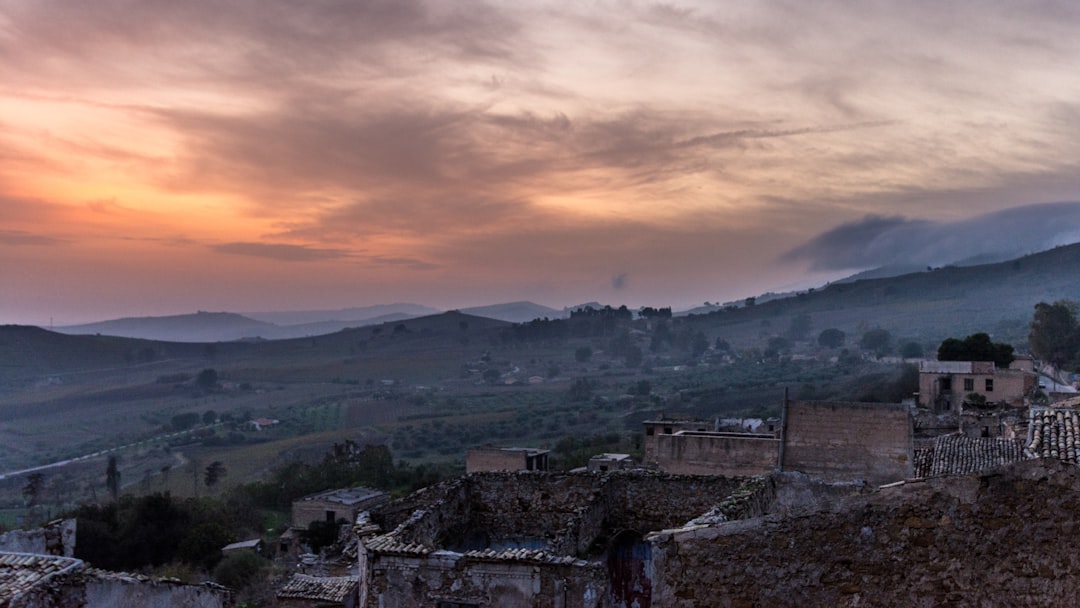
What has been left is not ruin in the sense of destruction. The buildings — dry-stone construction in the local grey-green slate, with dark wooden beams and roof tiles of the same material — are durable enough that many stand substantially intact despite decades of neglect. The terracing holds, though the walls in the most abandoned areas are beginning to collapse. The chestnut forests have grown back over what were once cultivated fields and are now the dominant landscape feature of the abandoned zones, their spring foliage covering the hillsides in a uniform green that makes the surviving walls and buildings visible only on close approach.
The Valle Scrivia: A Gateway to the Interior
The Valle Scrivia, running north from Genoa along the course of the Scrivia river, provides access to some of the most characteristic Apennine hill country in Liguria. The villages of the upper valley — Casella (accessible by a narrow-gauge railway that is itself a heritage attraction, the only remaining section of the historic Genoa-Casella line), Torriglia, and the smaller settlements above — are the entry points for the walking routes into the higher ground where the abandoned villages are found.
The pattern of abandonment follows the altitude: the villages at valley bottom or on easily accessible slopes are still inhabited, smaller, and maintain a basic service infrastructure. Those at higher altitude or on particularly steep slopes that made terracing marginally productive at best are the ones that emptied first. Walking from a functioning valley village upward along the old mule paths reveals this gradient: the inhabited zone gives way to partially abandoned settlements, then to completely empty ones, then to the terraces and walls of fields that haven’t been cultivated in half a century.
The walking routes through this landscape are the old connective tissue of the mountain economy: paths between villages, paths to the high pastures, paths along the ridge crests that once served as the principal travel routes before the valley roads were built. Some are maintained by the local mountain hiking associations and marked with the waymarks of the Federazione Italiana Escursionismo; others have been reclaimed by vegetation and require map and compass rather than following waymarks.
Pentema: A Village Preserved
Pentema, above Torriglia in the upper Valle Scrivia, is one of the best-preserved and most visited of the Ligurian abandoned village circuit. Unlike many of the completely depopulated settlements, Pentema retains a small permanent population and has been the subject of a sustained restoration effort: the buildings have been stabilised, the lanes cleared, and the village is known for its extraordinary presepe — a nativity scene that uses the entire village as its setting, with hundreds of lifelike terracotta figures placed in the actual spaces of the village buildings, lanes, and courtyards.
The presepe tradition in Pentema is documented from the 19th century and has grown over time into a complete visual representation of mountain village life: the figures include not only the traditional nativity scenes but the full range of the village economy — the smith at the forge, the woman at the well, the shepherd on the hillside above, the village mill in operation. The effect of moving through a village where the empty buildings have been populated by these figures is one of the stranger heritage experiences in Liguria, and the quality of the craftsmanship — the figures are carved and painted with genuine skill — keeps it from being merely sentimental.
The Dry-Stone Walls: A Technical Heritage
One of the underappreciated aspects of the abandoned Ligurian villages is the quality of their dry-stone construction. The retaining walls that support the terracing, the house walls, the paths — all constructed without mortar in the local grey-green slate — represent a tradition of building in stone that was developed over centuries and refined to a precision that modern construction cannot easily replicate. The absence of mortar means that the walls move slightly with the ground, distributing the stress of the hillside rather than resisting it, and well-built walls of this kind survive for centuries without significant maintenance.
The organisations dedicated to maintaining these traditional building skills — there are several in Liguria, some connected to the regional government’s agricultural policy and some simply voluntary — are engaged in what amounts to cultural archaeology as much as practical construction. Learning to rebuild a dry-stone terrace wall in the Ligurian style, with the specific techniques of the local tradition, is available as a short course in some of the valley communities and provides a physical engagement with the abandoned landscape that walking through it does not.
The Food of the Abandoned Interior
The cuisine of the Ligurian interior is the food of the mountain economy that built and abandoned these villages: chestnut-based preparations (chestnut flour pasta, chestnut soup, the various sweet and savoury uses of the nut that was once the primary food of the mountain poor), wild mushrooms from the forests that have replaced the cultivated fields, lamb and kid from the pastoral economy that still functions at reduced scale, and the herbs of the Apennine meadows — the wild thyme, rosemary, and savory that grow on the sunny hillsides above the treeline.
Pesto Genovese — the basil sauce that is the most internationally recognized product of Ligurian cuisine — has its origins in the coastal lowlands rather than the mountain interior, but the combination of pine nuts, aged sheep’s cheese, olive oil, and garlic that characterises the traditional version connects to a food culture that spans coast and mountain in a continuous exchange that the abandonment of the villages has disrupted but not entirely severed. The trattorie of the valley towns — Torriglia, Casella, the larger centres of the upper Valle Scrivia — offer mountain versions of the Ligurian table: heavier, more focused on preserved meats and dried legumes, less dependent on the coastal fish and vegetables that define the lowland cuisine.

The Practical Experience of Abandonment
Visiting abandoned villages requires some preparation that the typical Italian sightseeing itinerary does not. The physical state of the buildings means that entering structures is potentially dangerous — roofs have fallen in some cases, floors in others — and the experience is primarily one of exterior investigation rather than interior exploration. A good map of the area (the Kompass 1:50,000 sheets for the Ligurian Apennines are the most useful) and a GPS or mapping app with offline capability are advisable for routes that go beyond the maintained walking paths.
The seasonal timing matters more here than in most Italian destinations. Spring and early summer (April to June) offer the best combination of walkable conditions, cleared paths (winter debris removed by the hiking associations), and the visual contrast between the emerging vegetation and the grey stone of the buildings. Autumn (September to October) has the advantage of the chestnut harvest season, when the forests are more actively used and the villages occasionally have visitors for mushroom picking and nut gathering.
The Ligurian interior is accessible by car from Genoa in 45 minutes to an hour, and several of the valley railway lines provide public transport access to the lower valley towns. The experience of the abandoned villages themselves requires either a car to the trailhead or a combined train-and-walk approach that adds significantly to the travel time. The Genoa-Casella narrow gauge railway, running from Piazza Manin in Genoa to Casella in the upper valley, is a historical attraction in its own right and a pleasantly slow approach to the walking country above.