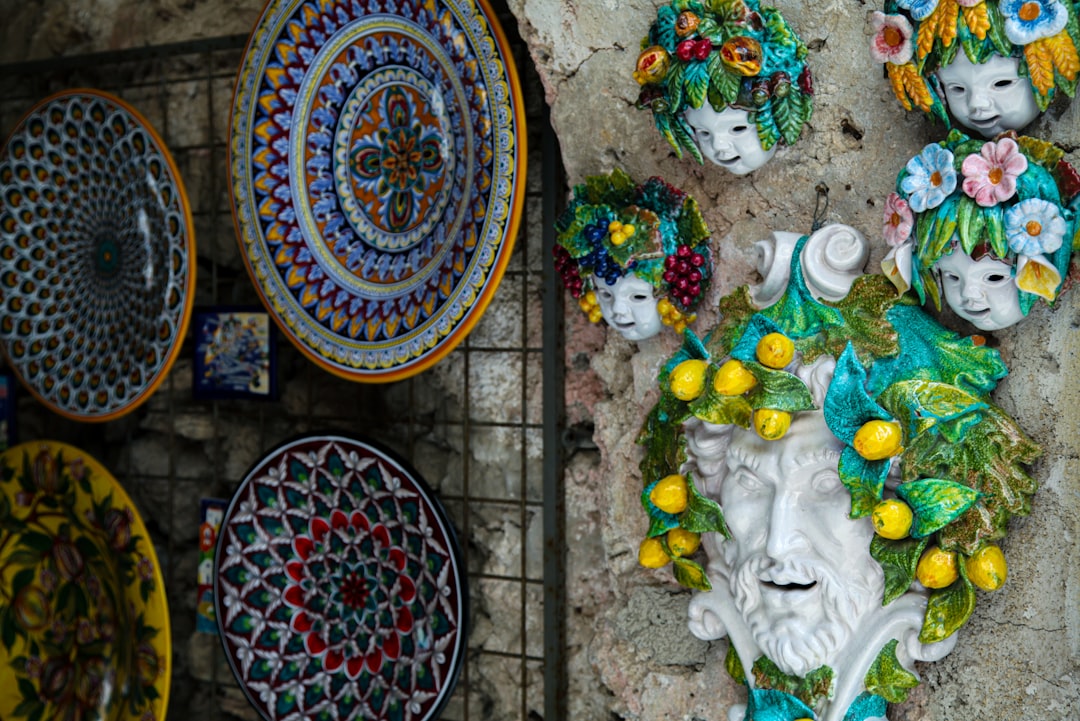
The road entering Deruta from the south is lined on both sides with shops selling ceramic objects. This is not a recent development: the association between Deruta and decorated maiolica ceramics has been documented since the fourteenth century and represents one of the most persistent craft specialisations in Italy. The town of roughly nine thousand people on the Umbrian plain south of Perugia has produced pottery in continuous tradition for six hundred years, surviving wars, economic crises, the development of industrial ceramics, and the fluctuations of the tourist market. The craft endures because the techniques developed here during the Renaissance — the tin-glazed earthenware with its characteristic blue, orange, yellow, and green palette on a white ground — remain impossible to mechanise without losing the qualities that make them distinctive. (See also: Cittaslow)
The Deruta maiolica tradition is specific in both technique and design vocabulary. The base clay, fired first at a low temperature, is dipped in a white tin oxide glaze. The design is then painted directly onto the unfired glaze surface — a process that requires precision and confidence, since mistakes cannot be corrected and the colours look different wet than they will after the final firing transforms them. The piece is fired a second time, and the glaze fuses to the clay, trapping the design beneath a glossy surface that has not changed substantially in technique since the fifteenth century.
The Design Traditions
Deruta’s most famous design — the Raffaellesco, with its central grotesque mask and swirling leaf and dragon motifs in blue and orange — dates from the late fifteenth century and was already being attributed to Raphael’s influence by the sixteenth. Whether or not the connection is historically accurate, the Raffaellesco has been a continuous production at Deruta for five hundred years and remains the most recognisable single design in Italian decorative ceramics. It appears on plates, jugs, tiles, lamp bases, and objects of every conceivable type in every Deruta shop.
More interesting, for those with some knowledge of Italian ceramic history, are the other Deruta traditions: the lustred ware (lustro) that was produced in Deruta from the early sixteenth century using a technique borrowed from Spanish maiolica, which added a metallic iridescence to the finished surface; the blue-on-white designs in the style of the seventeenth-century Dutch and Chinese imports that influenced Italian ceramic design throughout the baroque period; and the contemporary Deruta workshops that maintain the traditional techniques while developing new designs.

Workshops and Courses
Several Deruta workshops offer hands-on courses for visitors. The standard format is a half-day or full-day session in which participants work with a craftsperson on a specific technique — typically the painting stage, since throwing the clay and applying the base glaze require more extended training to reach even basic competence. The experience of painting directly onto the unfired glaze surface — understanding the opacity of the colours in their wet state, the need to commit to each brushstroke without correction — is genuinely instructive about the craft even in a single session.
The Museo Regionale della Ceramica di Deruta in the town’s historic centre provides the historical context that workshops cannot fully supply. The collection spans from medieval production through the Renaissance period that established Deruta’s international reputation to the twentieth-century industrial phase that maintained production volume while reducing the hand-craft element. The comparison between the Renaissance objects — the variability of hand painting, the slight irregularities of throwing, the evidence of individual makers — and the more standardised twentieth-century production illustrates the difference between craft and manufacturing more clearly than any theoretical description.
Deruta is twenty minutes by road from Perugia and can be combined with a visit to Perugia’s Galleria Nazionale dell’Umbria or the Rocca Paolina. The surrounding Umbrian countryside — this is the broad Tiber valley south of Perugia — is agricultural rather than dramatically scenic, but the town itself, with its workshops and museum, warrants several hours of serious attention.
Photo: Tamara Malaniy on Unsplash