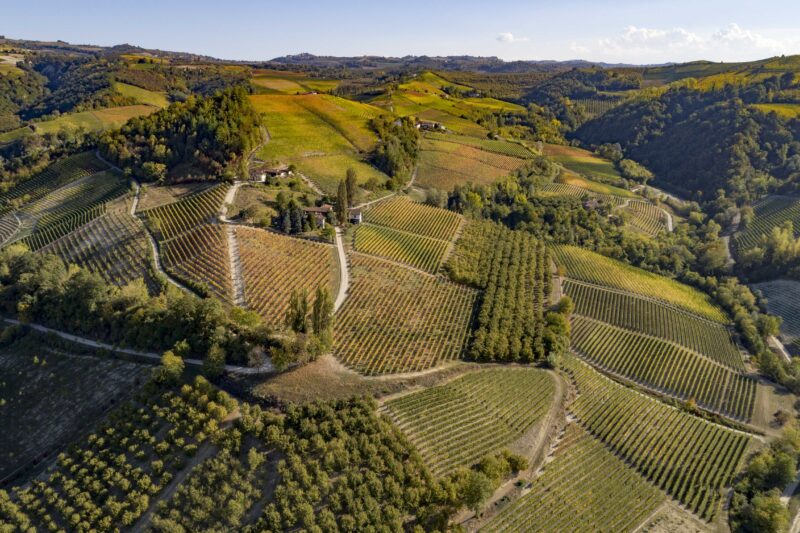
The Langhe hills in autumn are one of the most beautiful landscapes in Italy. The vineyards turn gold and copper and the deepest burgundy, the morning fog rolls in from the Po valley to fill the valleys between the ridges, and the villages of Barolo, Castiglione Falletto, Serralunga d’Alba, and La Morra emerge from the mist like illustrations from a fairy tale. This is the home of Barolo, the wine that Italians call ‘the king’ and that collectors around the world pursue with a passion bordering on obsession.
The Nebbiolo Grape and Why It Matters
Barolo is made from Nebbiolo, a grape variety of ancient lineage and deeply difficult character. It ripens late — harvest rarely begins before mid-October — and even fully ripe, its tannins are fierce, its acidity high, its colour paradoxically pale for a red wine with such power. The wine it produces is not immediately lovable: young Barolo is austere, demanding, challenging in ways that make many drinkers wonder what the fuss is about. The revelation comes with time. After eight to ten years of bottle ageing, the tannins soften into silk, the colour deepens towards garnet, and the aromatics — tar, roses, leather, violets, tobacco, forest floor — develop into a complexity that genuinely rivals Brunello di Montalcino and even Burgundy’s greatest Pinot Noirs.
The Villages and Their Styles
The Barolo zone is divided into roughly eleven villages, each with its own subzones (called MGA, menzioni geografiche aggiuntive) that express distinct characteristics derived from soil type, elevation, and aspect. The soils of Serralunga d’Alba — compact Helvetian limestone — produce wines of structure and longevity. The Tortonian soils of La Morra and Barolo itself, richer in clay and more fertile, yield wines of greater aromatic opulence and earlier approachability. Learning to taste the difference is one of the great intellectual pleasures of Italian wine.
Visiting the Barolo Wineries
The wineries of the Langhe range from the historic estates — Giacomo Conterno, Bruno Giacosa, Bartolo Mascarello — whose wines are among the most sought-after in Italy, to a newer generation of producers who have brought both innovation and respect for tradition to the zone. Visiting in October, when the harvest is underway and the cantinas are fragrant with fermenting Nebbiolo, offers an intimate experience of Italian wine culture at its most vivid. Many producers welcome visitors for tastings by appointment, and the combination of extraordinary wine, breathtaking landscape, and the truffled cuisine of the Langhe (covered in depth in our Langhe guide) creates an experience of concentrated pleasure that is hard to surpass anywhere in the world.
Alba’s annual White Truffle Fair, held from October through November, coincides perfectly with the moment when the new vintage is settling in tank and barrel and the cellars are briefly open and celebratory. The white truffle of Alba — Tuber magnatum pico, the most prized and most expensive truffle in the world — is shaved over tajarin and eggs and risotto in the restaurants around the fair, paired with young Barolo and older bottles that have been breathing since morning. It is a pairing of such extravagant, uncomplicated luxury that it seems almost impossible to justify to anyone who has not experienced it.
Barolo is not just a wine; it is a worldview — an argument for the virtues of patience, for the importance of place, for the belief that the best things in life improve with time and reward those who wait. In a world of instant gratification, it is a wine that demands and repays the long view.