Trieste occupies a position in Italian consciousness that no other city quite replicates: a port city on the northeastern edge of the country that was, for centuries, the principal maritime outlet of the Habsburg Empire, and whose identity was shaped so thoroughly by that Central European context that its incorporation into Italy in 1920 produced a cultural and social complexity that persists to this day. The city is Italian in language and administration, but its architecture, its café culture, its relationship to the sea and the Carso plateau above it, and its particular quality of melancholy and intellectual intensity belong to a tradition that traces more directly to Vienna and to Mitteleuropa than to Rome or Naples.
This is a city that produced or attracted James Joyce (who wrote most of Dubliners and began Ulysses here, teaching English and speaking Triestine dialect), Italo Svevo (the novelist whose Zeno’s Conscience is one of the major Italian novels of the 20th century), Claudio Magris (whose Danube is the most sustained literary engagement with the Mitteleuropa idea), and Umberto Saba (whose Canzoniere constitutes one of the great bodies of Italian poetry). The coincidence of literary achievement and geographic position is not accidental: the frontier position of Trieste — between languages, between empires, between orientations toward sea and continent — generates exactly the kind of cultural friction that literary production feeds on.

The Piazza Unità d’Italia and the Habsburg Legacy
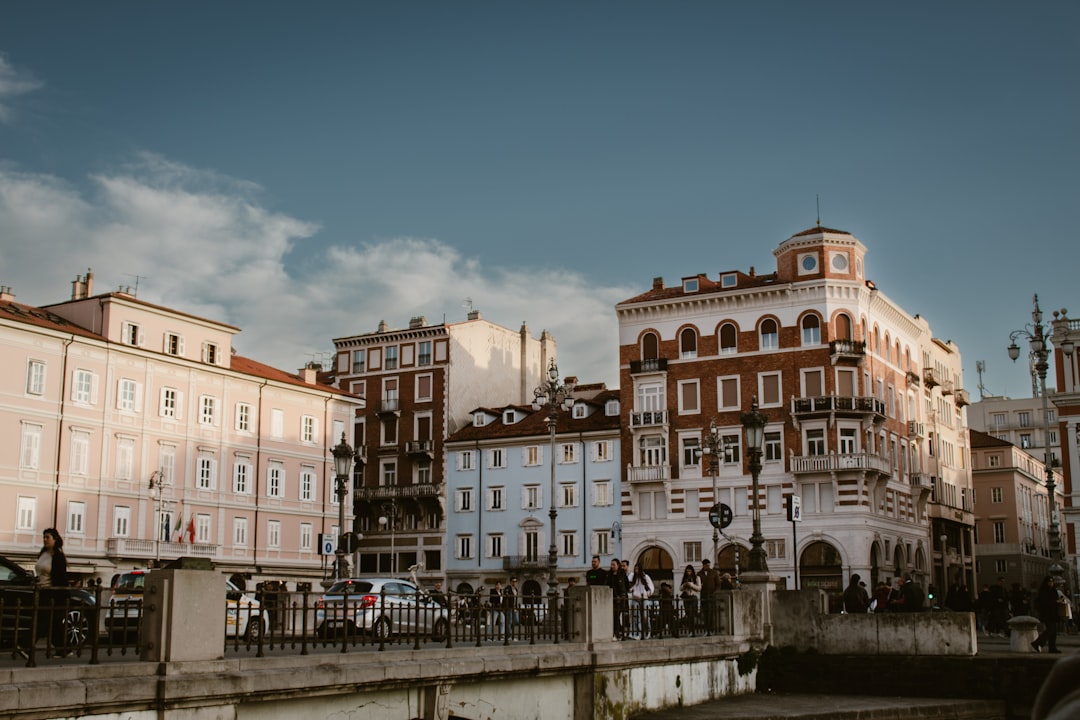
The Piazza Unità d’Italia — the main square of Trieste and one of the largest seafront piazzas in Europe — opens directly onto the Gulf of Trieste. Three sides of the square are bounded by monumental Habsburg-era buildings: the Palazzo del Municipio, the Palazzo della Prefettura, the Palazzo del Governo. The fourth side is the sea. The scale and the orientation of the square — the deliberate visual relationship between the institutional architecture and the maritime horizon — express something about the Habsburg ambition for Trieste that the words “free port” and “imperial outlet” only partially convey. The empire built the city to face the Mediterranean, and the piazza is the most direct expression of that intention.
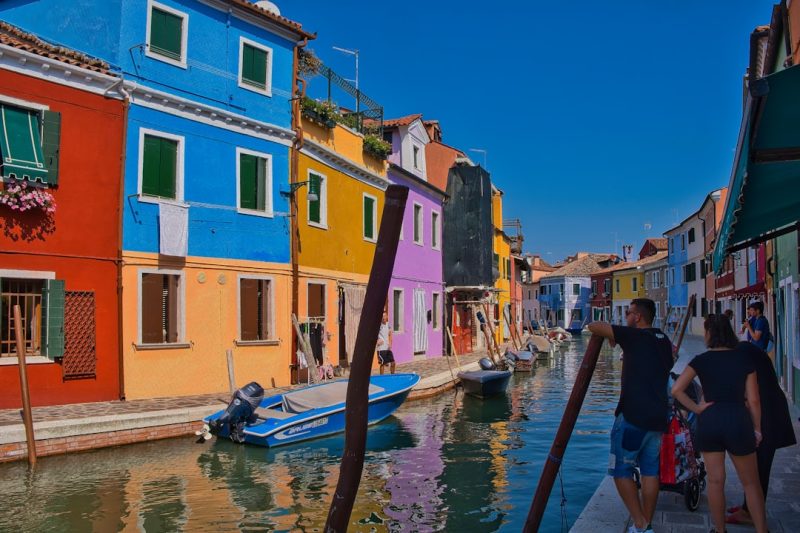
The neoclassical and neo-baroque buildings that line the Borgo Teresiano — the grid of streets laid out by the Habsburg administration in the 18th century north of the old city — are the most intact expression of rational 18th-century urban planning in northeastern Italy. The Canal Grande, cut into the city grid and still lined with boats in the manner of a miniature version of the Venetian system it was modelled on, is the organisational spine of the Borgo Teresiano and the most photogenic single element of the Habsburg urban fabric.
The Serbian Orthodox Church of San Spiridione, at the Canal Grande, and the Greek Orthodox community’s church nearby are physical evidence of the commercial diversity that made Trieste function as an international port: the Habsburgs encouraged the settlement of communities from across the empire and the Mediterranean basin, and the religious buildings they left behind constitute a record of the city’s cosmopolitan trading history that the predominantly Italian-language contemporary city does not otherwise make immediately legible.
The Caffè Culture
Trieste has a caffè culture that is distinct from any other Italian Italian coffee culture tradition. The terminology is different — ordering a “coffee” in Trieste without specifying the local term produces confusion; the standard espresso is a “nero,” a caffè latte is a “capo in b” (cappuccino in a glass), and the vocabulary continues with variants that reflect the city’s particular relationship with coffee, which has been a serious matter since the Viennese café culture and the coffee trade of the Habsburg period established it as the city’s defining social institution.
The historic caffè of Trieste — the Caffè degli Specchi on the Piazza Unità, the Caffè San Marco in the Borgo Teresiano, the Caffè Torinese — are genuine heritage institutions in the sense that their function as social and intellectual gathering places has been continuous since the late 19th and early 20th centuries. The Caffè San Marco, which opened in 1914 and has operated continuously since (with the interruption of the Second World War, during which it served other functions), has the atmosphere of a central European café transplanted to an Adriatic port city: dark wood panelling, mirrors, marble tables, and the particular quality of a public space that has been serious about coffee and conversation for a long time.
Joyce used the caffè of Trieste as working spaces; Svevo met literary friends in them; Saba’s bookshop, the Libreria Antiquaria Umberto Saba, still exists (or did until recently) as a physical landmark of the literary culture that the caffè sustained. The relationship between the caffè as physical space, the literary culture it enabled, and the city’s specific geopolitical position is the Trieste intellectual triangle, and engaging with it through actual visits to the spaces — sitting in the San Marco with a capo in b, reading Svevo or Magris, watching the mix of pensioners, students, and the occasional confused tourist who expected something more conventionally Italian — is the most direct way of understanding what the city is about.
The Carso: The Plateau Above the City
The Carso — the limestone plateau that rises abruptly from the Gulf of Trieste to the east and northeast of the city — is one of the defining elements of the Trieste landscape and the source of the city’s particular relationship with wind. The Bora, the northeastern wind that blows from the Carso down toward the sea, is not a meteorological curiosity but a climatic reality that has shaped the city’s architecture, its urban design, and the psychological disposition of its inhabitants. Bora winds can reach speeds of 100 km/h and have been clocked at over 200; the city’s street furniture is anchored to the ground in some areas, and the characteristic ropes strung between buildings in the old town during Bora events — for pedestrians to hold onto — are real rather than picturesque.
The Carso plateau above the city, accessible by the historic tramway that climbs from Opicina on the city’s edge (when it is operational — the tram has been subject to extended closures for maintenance), is a landscape of a completely different character from the port city below. The plateau is karst terrain: limestone riddled with caves (the Grotta Gigante, one of the largest show caves in the world, is accessible from the Carso near Trieste), with thin soil and a sparse, drought-adapted vegetation. The villages on the Carso have a different architectural character from those of the coast — the local stone, a pale grey limestone called pietra carsica, gives the buildings a rougher, more austere appearance than the plastered walls of the city below.
The osmize — temporary establishments in farmhouses on the Carso where local Friuli wine, cold meats, and the specific Carso food tradition can be sampled — are one of the most distinctive food experiences in the Trieste area. The osmiza tradition (from the Slovenian word for “eight,” referring to the eight days during which Habsburg law allowed farmers to sell their produce directly from home) is still active, with establishments opening and closing seasonally and their locations published in local listings. Finding an osmiza on the Carso, eating the local prosciutto and cheese with the rough, tannic local wine, and looking down at the Gulf of Trieste and the city below from the plateau edge: this is the Trieste that doesn’t appear in most travel writing.
The Borderland Character
Trieste has been the border in different senses at different moments of its history. The border between the Habsburg and Ottoman spheres. The border between Italy and Yugoslavia after 1945, when the city was in a disputed zone (the Free Territory of Trieste, administered by Allied and Yugoslav forces) until its formal assignment to Italy in 1975. The border now between the Schengen zone and, until recently, the non-Schengen states to the east. The presence of Slovenia immediately to the east and Croatia within a short drive means that Trieste has a relationship with its neighboring countries that is intimate rather than abstract — the markets of the city have Slovenian vendors, the restaurants serve Slovenian and Croatian wines alongside Italian ones, and the cultural boundary between the Slavic and Italic worlds is immediately visible in the linguistic and social fabric of the port.
This borderland character — which is simultaneously the source of the city’s melancholy and its intellectual richness — is most directly experienced in the Rione di San Giusto, the hill above the city centre where the cathedral of San Giusto, the Venetian-era castle, and the Roman remains are clustered. From the hill, the panorama takes in the city, the gulf, and, on clear days, the Istrian coast across the water — the coast that was Italian in culture and population until the postwar period but is now divided between Slovenia and Croatia. The complexity of identity that the view suggests is not a historical abstraction in Trieste. It is the lived reality of a city that has been at the intersection of competing national projects for two centuries and has absorbed the consequences without fully resolving them.

The Food of Trieste
The cuisine of Trieste is the most complex regional cuisine in Italy in the sense of drawing from the widest range of influences: Austrian, Slovenian, Croatian, Jewish (Trieste had a large and significant Jewish community, whose cemetery and synagogue remain important landmarks), Greek, and Serbian culinary traditions have all contributed to a food culture that resists easy categorisation. The goulash that appears on Triestine menus is not quite Hungarian and not quite Austrian but a specific local version. The jota — a soup of sauerkraut, beans, and smoked pork — is the specific Triestine form of a preparation that exists in different versions across the entire Alpine-Adriatic zone.
The codfish preparations (baccalà, the salt cod that is the fundamental preserved fish of the Mediterranean) appear in a Triestine version that reflects the Venetian heritage more than the Austrian one. The mixed seafood of the Gulf — the fish markets of the Ponterosso sell the daily catch from the local fishing fleet — is prepared in the city’s fish restaurants with a simplicity that reflects the quality of the product. The pastry tradition, predictably, reflects the Viennese influence: the strudel and the krapfen (the Austrian doughnut) coexist with the Italian cornetto and the Triestine putizza (a rich yeast cake with walnuts, raisins, and pine nuts, related to the Slovenian potica).
Expect to spend €20-35 per person for a full meal in a good Triestine trattoria. The wine list will typically include both Italian and Slovenian wines — the Collio DOC zone, producing excellent white wines from Friulano, Malvasia, and Ribolla Gialla grapes, straddles the Italian-Slovenian border and its wines are common in Trieste restaurants on both sides of the denomination.
Practical Notes
Trieste is served by the Trieste Airport (Ronchi dei Legionari), which handles a range of European flights. The city is connected to Venice by rail (approximately 2 hours on the fast service) and to Ljubljana (approximately 2.5 hours) and other Central European destinations. The city is compact enough to explore entirely on foot, with the historic centre, the waterfront, and the hill of San Giusto all walkable from the main railway station. The tram to Opicina on the Carso, when operational, provides the most atmospheric approach to the plateau. The optimal season is spring and autumn; the Bora can make winter uncomfortable but gives the city a dramatic atmospheric quality that is not unattractive to visitors who have come specifically to understand what Trieste is.