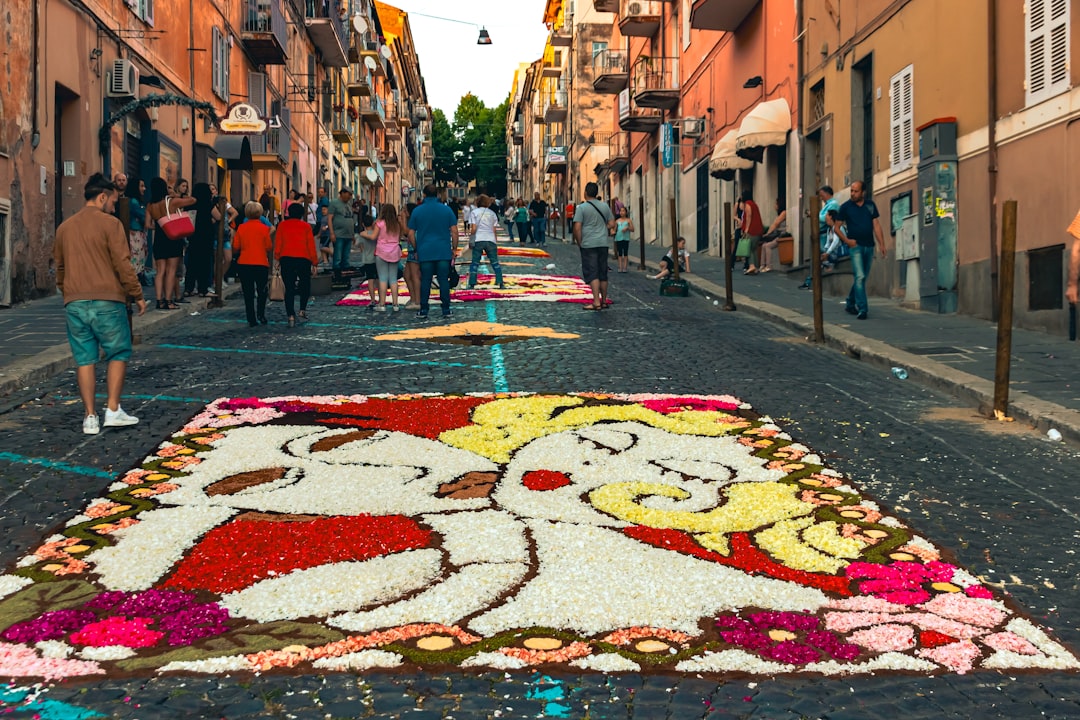
The infiorata is a tradition of decorating streets, piazzas, and processional routes with designs made from flower petals, arranged flat on the ground in patterns of varying complexity and scale that are destroyed when the religious procession — typically the Corpus Christi procession — walks over them. The destruction is part of the point. The petals of the design, prepared over many hours by large numbers of people working in coordination, are intended to be walked on by the priest carrying the Eucharist, and the transience of the creation — hours of work dissolved in minutes — is an expression of the devotion that produced it. The infiorata tradition exists in numerous Italian towns, particularly in Lazio, Umbria, and the south, but the most celebrated examples are those of Spello in Umbria and Genzano di Roma in the Castelli Romani.
The contemporary infiorata has evolved beyond its strictly religious function: the designs have become increasingly elaborate and ambitious, incorporating not only religious imagery but secular subjects (portraits, landscapes, abstract patterns), and the skill and artistry involved in the best examples rivals that of any other temporary public art form. The teams who create the infiorata work through the night before Corpus Christi, laying the petals with tweezers and small spatulas to achieve designs with the precision of a mosaic, and the morning reveal — when the barriers come down and the completed works are visible for the first time in their totality — is one of the more extraordinary spectacles in the Italian Italian festivals calendar.
Spello: The Most Celebrated Infiorata
Spello is a small hill town on the western slopes of Monte Subasio in Umbria, close to Assisi, with a remarkably complete medieval and Renaissance urban fabric and a Roman heritage visible in the Porta Venere and the Via Consolare. It is, by the standards of Umbrian towns, relatively well-visited — the proximity to Assisi and the quality of the Pinturicchio frescoes in the Baglioni Chapel of the church of Santa Maria Maggiore draw visitors throughout the year. But the infiorata transforms the town for one day into something of a different order: a complete decorative environment in which every significant street and piazza has been converted into a floor mosaic of flower petals.
The Spello infiorata runs on the Sunday of Corpus Christi (which falls between late May and mid-June depending on the Easter date). The preparations begin on Saturday evening and continue through the night, with each neighbourhood and each participating group responsible for a defined section of the route. The sections vary in size from a few square metres to large piazza areas, and the designs range from the simple geometric patterns produced by local schoolchildren to the extraordinarily complex figurative compositions of the most experienced groups.
The best sections of the Spello infiorata, viewed in the early morning before the procession, have the quality of large-scale Renaissance paintings laid on the ground — the figurative accuracy of the faces, the rendering of drapery and landscape, and the tonal range achieved by the selection of petals in carefully graded colours are at a level that makes the medium genuinely impressive. The total length of the infiorata route in Spello is approximately 2 kilometres, and viewing the complete work before the procession takes the full morning. After the procession, which walks the route in the early afternoon, the petals are scattered and the work is over.
The Flower Preparation: A Community Enterprise
The petals used in the infiorata come from a specific range of flowers selected for their colour retention and the ease with which they can be laid flat. The yellow of broom, the red of roses, the white of daisies and carnations, the blue of larkspur, the purple of wisteria and lavender, the orange of marigolds — each colour has its typical flower source, and the preparation begins days before the event with the collection and sorting of petals from local gardens, florists, and in some cases from dedicated flower farms that supply the infiorata communities.
The petals are sorted by colour into containers, sometimes dried and pressed for specific effects, and the palette available to any given group is determined by what can be gathered in the week before the event. This ecological constraint on the colour palette — you can only use the flowers that are in bloom in late May or June at the latitude of Umbria — gives the infiorata a specific seasonal character that would be lost if the materials were available year-round. The spring wildflowers of the Umbrian hills — the poppies, the cornflowers, the ox-eye daisies — appear in the infiorata in a way that connects the decorative tradition to the agricultural season.
The design teams begin laying petals in the evening, working from a cartone (a paper design, either drawn by the team or, in the more ambitious sections, prepared by an artist) that is transferred to the street surface in chalk before the petals are applied. The process is additive and requires constant coordination — the central design elements are typically laid first, with the border elements and backgrounds filled in around them — and a section of 20 square metres might require eight to ten people working continuously for six to eight hours. The physical closeness of the work (kneeling on the street surface for hours, manipulating individual petals with precision) is one of the aspects of the infiorata that photographs don’t convey.
Genzano: The Roman Infiorata
Genzano di Roma, in the Castelli Romani hills south of Rome, runs the oldest documented Italian infiorata — the tradition here is recorded from the 18th century — and the scale of its event makes it the most substantial outside Spello. The Via Italo Belardi, the main street of the historic centre, is covered over a length of approximately 200 metres with a design that changes each year according to the theme chosen by the organising committee. The Genzano infiorata has in recent decades incorporated contemporary artistic themes alongside the traditional religious subjects, and some of the most ambitious examples — reproductions of Old Master paintings, complex allegorical compositions — have been created by groups whose members have practised the technique for generations.
The Genzano event runs over the Corpus Christi weekend and includes a competition among the participating sections, with prizes for the best execution of the year’s theme. The competition element has driven a level of technical ambition that the purely devotional tradition of smaller infiorata towns does not produce, and the Genzano examples are among the most technically accomplished flower-petal images created anywhere. The disadvantage of the competition format is a loss of spontaneity — the competitive infiorata sections are more calculated and less immediately surprising than the best non-competitive examples — but the level of craft achievement is undeniable.
Other Notable Infiorata Locations
The infiorata tradition exists across a wide geographic range in Italy, with significant events in Bolsena (Lazio), Noto in Sicily (where the spring Infiorata di Noto has developed independently of the Corpus Christi calendar and runs in May), Diano Marina in Liguria, and numerous smaller towns throughout Lazio, Umbria, Campania, and the south. The Sicilian infiorata — particularly the Noto event, which has grown into one of the major spring festivals of southeastern Sicily — has developed its own aesthetic character, with a greater emphasis on floral abundance and the specific Mediterranean palette of flowers available in the Sicilian spring.
Attending the Infiorata: Practical Notes
The Corpus Christi date varies by year (it falls on the Thursday 60 days after Easter, or in Italy often moved to the following Sunday): in 2024 it fell on June 2, in 2025 on June 22, in 2026 on June 14. Checking the specific date for the year of your visit is essential, since the infiorata events are only on this single date.
The best time to view the infiorata at Spello and Genzano is the morning of Corpus Christi, in the period between when the barriers come down (typically around 8:00) and when the procession begins (mid to late morning). After the procession, the works are damaged beyond viewing. The overnight viewing is possible at both locations — the communities are generally welcoming of visitors who want to watch the preparation process, and being present as a section comes together in the pre-dawn hours gives a completely different perspective on the tradition than the morning-light viewing of the completed work.
The Infiorata as Devotional Act
The broader context of the infiorata — as a form of votive offering, a physical expression of faith through dedicated labour and the offering of beautiful things to be destroyed — connects it to a Mediterranean tradition of temporary sacred art that includes the Easter sand paintings of Calabrian towns, the elaborate temporary altars of the Sicilian Easter, the offerings of candles and wax figures at pilgrimage shrines throughout the south. The act of making something beautiful and giving it to be destroyed is an expression of a religious sensibility that the contemporary secular tradition of the infiorata preserves even as the devotional intent recedes in the minds of some of its participants.
The most interesting version of the infiorata — for the visitor who wants more than the photographic spectacle — is the one that can be found in the small towns where the tradition remains primarily devotional rather than touristic, where the groups who prepare the designs are the church sodalities and parish communities rather than competitive teams, and where the morning of Corpus Christi is primarily a religious event with a visual component rather than a visual spectacle with a religious pretext. These events require more effort to find and visit, but they preserve something that the larger and more celebrated events have partially lost.