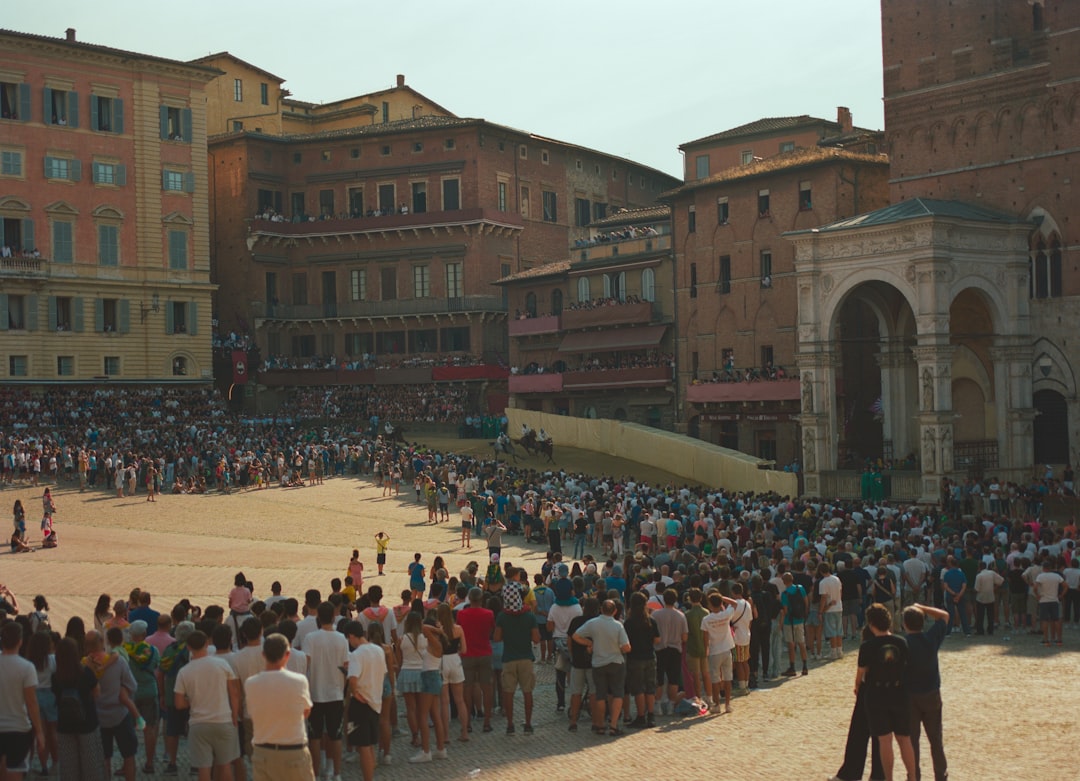
The Palio di Siena is run twice a year — on July 2 and August 16 — in the Piazza del Campo, the shell-shaped medieval Tuscan town square at the centre of the city. Seventeen of Siena’s contrade (the city’s ancient neighbourhoods, seventeen in number) compete, though each race involves only ten horses drawn by lot; the seven contrade not selected each race alternate in future years according to a rotation. The race lasts approximately 90 seconds. The preparation for it occupies the entire social and political life of the city throughout the year.
The Palio is not a tourist event with local participation. It is a local event that tourists are permitted to observe. The distinction is not semantic. The race is run for the contrada that wins it — the prize is a banner (the palio, a silk painting of the Virgin Mary, different each year and created by a different artist) — and the celebration, the tears, the anger, and the complex political manoeuvring that accompanies each running of the race belong to the contrade and their members in ways that no visitor can fully enter. Understanding the Palio requires beginning with this asymmetry: the visitor is present at something that would happen exactly as it does whether the visitor were there or not.
The Contrade: The Social Architecture of the Palio
Siena is divided into seventeen contrade — the Aquila (Eagle), the Bruco (Caterpillar), the Chiocciola (Snail), the Civetta (Owl), the Drago (Dragon), the Giraffa (Giraffe), the Istrice (Porcupine), the Leocorno (Unicorn), the Lupa (She-wolf), the Nicchio (Shell), the Oca (Goose), the Onda (Wave), the Pantera (Panther), the Selva (Forest), the Tartuca (Turtle), the Torre (Tower), and the Valdimontone (Ram) — each with its own territory within the historic city, its own symbol and colors, its own museum, its own church, its own fountain, and its own social life that runs parallel to and largely independently from the civic institutions of the city.
Membership in a contrada is determined by birth: a child born in a contrada’s territory is baptised into the contrada at its fountain in a ceremony that constitutes a second baptism, and membership is for life. The contrada is the primary social unit of traditional Sienese identity — more immediate than the city itself, and in many ways more deeply felt. The rivalries between contrade (particularly the enemy pairs — the Chiocciola and the Torre are historical enemies, the Oca and the Torre, and others — whose mutual antagonism is maintained across generations) are real and intense, and the alliances formed between contrade for any given Palio (one contrada will often pay the jockey of a rival to obstruct the specific enemy) constitute a political game of considerable complexity.
The contrada society — its dinners, its processions, its ceremonies throughout the year — is the context for the three days of intense activity that precede the race. The trial races (prove) that run on the five days before the Palio, the assignment of horses and jockeys (the jockeys, fantini, are professionals who are negotiated for and bought, sometimes corruptly, by the contrade in the days before the race), the final trial race on the morning of the Palio itself — all of these are preceded and followed by the social life of the contrada, the dinners in the streets of the neighbourhood, the arguments about tactics and alliances, and the building of collective emotion that the race itself discharges in 90 seconds of controlled chaos.
The Race Itself
The horses run three laps of the Piazza del Campo — the square packed with spectators in the centre, the stands around the edges filled with paying ticket holders — at speeds that make the tight curves of the San Martino corner (where the most accidents happen, the horses sliding on the dirt surface, occasionally throwing their riders) genuinely dangerous for the horses and the jockeys. A riderless horse that completes the race counts as a winner — the horse wins for the contrada, not the jockey, and the sight of a riderless horse crossing the finish line ahead of the field has happened more than once and is among the more dramatic moments in the Palio’s history.
The jockeys ride bareback, which is part of the tradition but also part of the risk: the contact between a bareback rider on a galloping horse making tight turns on a clay surface produces falls that sometimes result in serious injury. The Palio’s relationship with animal welfare has also been a subject of growing attention, as the race conditions — the sharp San Martino corner, the crowded start, the potential for pile-ups — have resulted in horse injuries and deaths in some runnings. The city’s response to these concerns has involved modifications to the track surface and the introduction of more protective padding at the most dangerous corners, but the fundamental conditions of the race remain unchanged, because the race is exactly what it is and changing it substantially would change its identity.
The moment of the victory — the fantino raising his hand, the mossiere (starter) raising the flag — releases an explosion of emotion from the winning contrada’s members in the piazza that is among the more viscerally affecting crowd experiences in Italy. The losing contrade, and particularly the historical enemies of the winner, receive the outcome with equal but differently directed emotion. The palio banner is carried to the cathedral, then to the contrada’s church, and the celebration that follows in the winning neighbourhood extends for days.

The Historical Pageant: Before the Race
The two hours before the Palio are occupied by the historical pageant (corteo storico) — approximately 600 participants in 15th-century costume, representing the contrade and the historic institutions of the Republic of Siena, parading around the Piazza del Campo with the medieval banners, drums, and the sbandieratori (flag-throwers) whose display of flag-throwing skill is a performance tradition of considerable age. The pageant is itself a significant spectacle: the costumes are historically accurate in their construction and maintenance, the drumming is practised throughout the year by the contrade, and the flag-throwing — the alfieri tossing their banners in complex patterns that require long training — is a craft performed at a level of skill that makes it worth watching independently of the race it precedes.
The historical pageant ends with the entry of the carroccio — a cart drawn by four white oxen and bearing the current year’s palio banner — and the final arrangement of the horses and jockeys at the starting line (the mossa). The mossa itself is one of the most dramatic procedural elements of the Palio: the horses are lined up between two ropes (a front rope held by the mossiere and a back rope that springs up at the start), and the start is called when the mossiere judges that the horses are properly arranged. False starts are common; the manoeuvring by jockeys to gain advantageous position before the start can prolong the mossa for many minutes, and the crowd’s tension increases with each failed attempt.
Watching the Palio: The Practical Options
The centre of the Piazza del Campo is free and accessible to all — the tradition is that this space remains open, though standing room in the centre can mean arriving several hours before the race to secure a reasonable position. The heat in July is considerable, and standing for three to four hours in direct sunlight in a packed crowd is a physical challenge that should be assessed honestly. The centre of the piazza is nonetheless the most authentic way to experience the race, and the proximity to the track surface and the crowd energy is not replicated from the stands.
The stands around the perimeter of the piazza provide seating, shade in some sections, and a view of the full track. Tickets for the stands are arranged through the contrade (whose members have priority) and through the city’s official Palio ticketing, and for the July Palio in particular should be sought months in advance. The windows and balconies of the buildings around the piazza, overlooking the track, are privately owned and their use on Palio days is arranged privately, at prices that can be very high for the best positions.
The July Palio (July 2) is generally considered the more important of the two annual races, dedicated to the Madonna of Provenzano, while the August Palio (August 16) is dedicated to the Assumption. Both are identical in structure and formality; the difference in importance is felt within the contrade more than it is visible to outsiders.

The Weeks Before: When Siena Is Most Itself
The most revealing engagement with the Palio is not the race itself but the days that precede it. The trial races, which begin five days before the Palio and run twice daily (morning and evening), are open and free to observe, and the atmosphere around them — the small crowds of contrada members, the argument about the horses’ form, the presence of the jockeys negotiating in the margins — is entirely different from the spectacle of the race day. The dinners that the contrade organise in their streets in the evenings of the week before the Palio — hundreds of people eating at long tables in the medieval lanes, the contrada songs being sung, the flags above the tables — are the domestic version of the Palio tradition, available to any visitor who understands what they are walking into.
Siena is one of the finest medieval cities in Italy at any time of year — the Piazza del Campo, the cathedral (Duomo) with Pisano’s pulpit and the Piccolomini library’s extraordinary frescoes by Pinturicchio, the Museo Civico with Simone Martini’s Maestà and Ambrogio Lorenzetti’s Allegory of Good and Bad Government — but in the days before the Palio, the city adds to its permanent historical depth the specific energy of a community preparing for the event that most completely defines its identity. For those who find the race itself too crowded or too brief, arriving in Siena four to five days before the race and leaving after the first trial race has given them the flavour they need is often a more satisfying engagement with the Palio tradition than the race day itself.