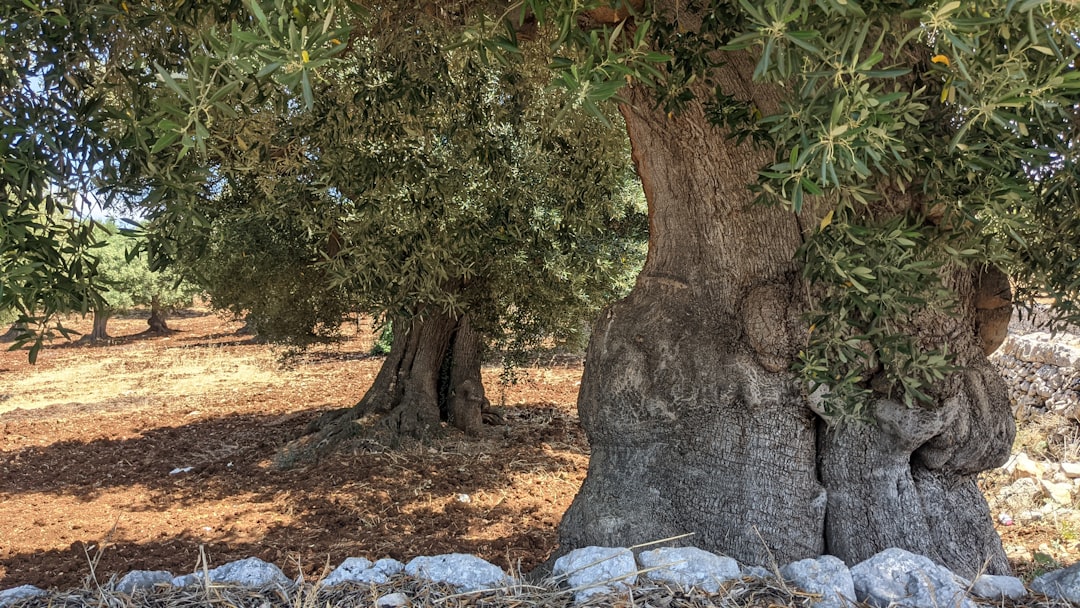
In November, the colour of Puglia changes. The grey-green of the olive groves — pervasive, continuous, stretching from the northern Tavoliere down through the Valle d’Itria and into the deep south — becomes the governing fact of the landscape, not merely its backdrop. The harvest is underway, and what happens in these weeks will determine the quality of oil that the region produces for the following year. Puglia accounts for roughly forty per cent of Italy’s total olive oil production, and in exceptional years considerably more. Understanding why requires understanding the tree, the variety, and the pressing process that converts one into the other.
The dominant olive cultivar in Puglia is Coratina, named for the town of Corato in the province of Bari. It is a variety of considerable character — productive, late-ripening, high in polyphenols, and capable of producing oil with an intensity that is, by any reasonable measure, aggressive. Fresh Coratina oil tastes of artichoke, green tomato, and fresh-cut grass, with a peppery finish that catches at the back of the throat. This finish — piccante in Italian, caused by oleocanthal, a polyphenol with anti-inflammatory properties — is considered a quality indicator by producers and a defect by people who encounter it expecting mild, buttery oil. It is neither. It is what Coratina tastes like when it is made properly.
The Trees
The olive trees of Puglia are old in a way that is difficult to convey without standing among them. The region contains an estimated sixty million olive trees — more than any other region in Italy — and a significant proportion of those trees are centuries old. In the Salento peninsula and around Monopoli and Ostuni, trees with trunks several metres in circumference continue to produce olives that are harvested and pressed in the same mills that have operated in the same locations for generations. These are not ornamental trees or heritage specimens protected from use: they are working agricultural assets that produce a harvest every autumn.
The gnarled, hollow-trunked form that old olive trees develop is not simply aesthetic. The twisting of the wood as it ages increases structural stability against wind; the hollowing of old trunks does not impair function, as the vascular tissue remains at the perimeter. Trees that have survived multiple centuries have also survived drought, frost, and the Xylella fastidiosa bacterial outbreak that has killed millions of younger trees across Salento since 2013, though not universally — the question of which trees carry natural resistance to Xylella is one of the more pressing subjects in current Italian agricultural research.
The Harvest
The harvest window for Coratina typically runs from late October through November, though in years with unusual weather patterns it extends into December. The timing matters enormously. Olives picked earlier, when the fruit is still green and firm, yield oil with higher polyphenol content and greater aromatic intensity — the oil that producers enter in competitions and sell at premium prices. Olives left longer on the tree, to darken and soften, yield more oil by volume but with less flavour complexity and lower polyphenol content. The commercial logic runs toward later picking; the quality logic runs earlier.
Small and artisan producers harvest by hand or with mechanical rakes that knock olives into nets spread beneath the trees. Industrial operations use mechanical harvesters that grip the trunk and vibrate it, dropping the fruit in seconds. Both methods work; the difference is in the bruising the fruit sustains. Bruised olives begin fermenting immediately, and fermented olives produce oil with defects that are detectable in the final product — a fusty, musty quality that trained tasters identify as a sign of poor handling. The best oils come from fruit that was harvested carefully, transported quickly, and pressed within hours.
The Frantoio
The olive mill — frantoio in Italian — is at the centre of the pressing season’s social life. In towns across Puglia, the local frantoio operates continuously through November, processing the harvests of dozens of small growers who arrive with their crop in crates and wait while it is pressed. The smell of a working frantoio — green, grassy, intensely alive — penetrates the surrounding streets and becomes the defining sensory fact of the season. Growers who have harvested the same trees for their entire lives will stand at the press watching the colour of the oil that emerges, adjusting their assessment of the year’s quality as it flows.
Modern continuous-cycle presses have largely replaced the traditional stone mills and hydraulic presses of previous generations, and the results are typically better — the process is faster, the temperature is more controlled, and the yield of polyphenols is higher. Cold extraction, defined as processing at under 27 degrees Celsius, is the standard for serious extra virgin production; higher temperatures increase oil yield but degrade the volatile compounds that carry flavour. The phrase “cold pressed” on a label means something specific: the fruit was never heated during extraction.
What Extra Virgin Actually Means
Extra virgin olive oil is defined by two criteria: acidity below 0.8% (measured as oleic acid equivalent) and the absence of sensory defects as assessed by a trained panel. Both requirements must be met simultaneously; oil that passes the chemistry but fails the taste panel, or vice versa, cannot be labelled extra virgin. This is a higher standard than most people expect from a product that is routinely sold cheaply in supermarkets, and the gap between the legal standard and much of what is labelled extra virgin in commercial contexts has been widely documented.
Pugliese producers who take quality seriously will have their oil tested at accredited laboratories and, in some cases, will apply for the DOP designations that cover specific production zones within the region — Terra di Bari, Dauno, Terra d’Otranto, and others. These designations are not guarantees of quality beyond the standard, but they indicate that the producer has committed to a defined production protocol and geographic traceability. They are also, practically, the easiest way for a consumer to establish that the oil they are buying is what the label claims.
Buying and Using It
The best time to buy Puglian olive oil is November and December, when the new harvest is just pressed and the oil is at its most flavourful. Oil purchased from a producer in these months, stored in a cool dark place and used within a year, will taste dramatically different from the same oil after twelve months in a shop. Polyphenols degrade over time; the grassy, peppery character of fresh Coratina softens and eventually disappears. Oil does not become unsafe to eat as it ages, but it becomes less interesting — and the argument for paying a premium price weakens as the months pass.
In Puglia, fresh oil is not treated as a finishing ingredient to be drizzled sparingly. It is poured. Bruschetta in the region — grilled bread rubbed with garlic — receives a quantity of oil that would alarm a restaurant in northern Europe. Legume soups are finished with a vigorous pour that leaves a green slick on the surface. Raw vegetables are dressed with oil, salt, and nothing else, on the premise that the oil has enough character to carry the dish without assistance. This is the correct use of good Coratina: not as a background element but as the dominant flavour, present in an amount sufficient to actually register. Treating expensive oil as precious, to be used sparingly, misses the point of what it is.
For those visiting Puglia outside of November, the agriturismi and masserie that offer olive oil tastings are a useful context for understanding what is available. A serious tasting — where different varieties, different harvest dates, and different DOP zones are presented side by side — will do more to calibrate a palate for extra virgin olive oil than any description. The pepper at the back of the throat is not a sign of something going wrong. It is the signal that the oil was made correctly.