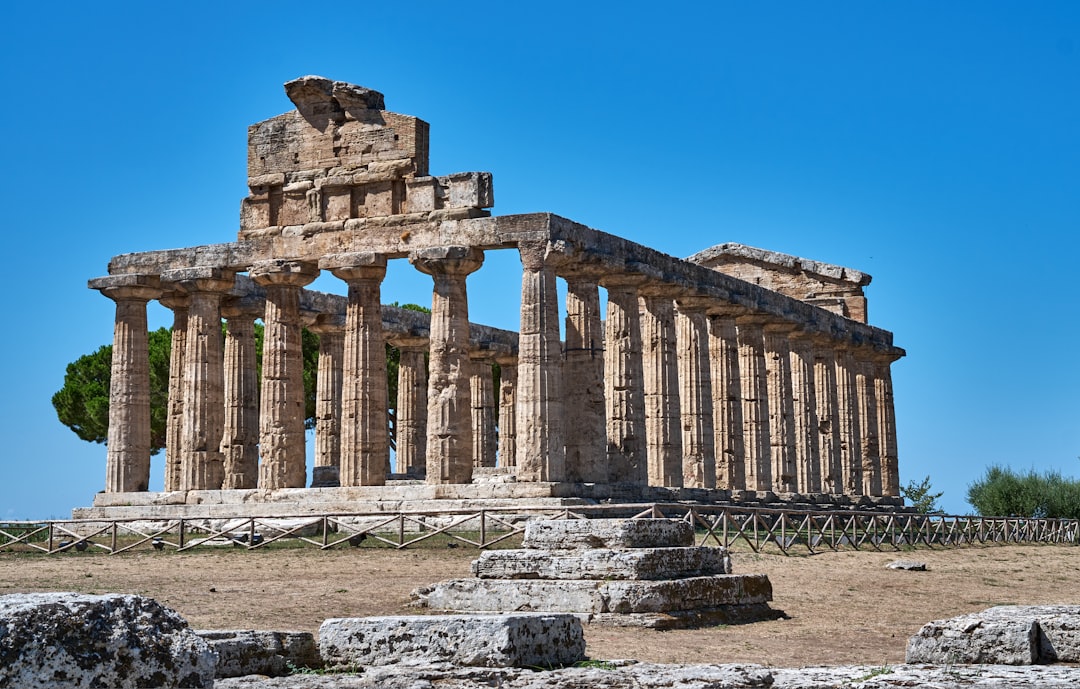
The Temple of Neptune at Paestum was built around 450 BC, at the height of the Greek colonial city’s prosperity. It stands 60 metres long, its thirty-six Doric columns supporting a trabeation of unusual completeness — the horizontal elements that normally collapse before the columns are mostly intact. The stone is a local travertine that has acquired a deep ochre colour over two and a half millennia. On a clear morning in spring, when the light is low from the east and the surrounding plain is green with young crops, the temple has a physical presence that the photographs, however good, do not adequately convey. You walk around it and the scale becomes clear: this is not a ruin of something that was once grand. It is still grand. (See also: Pompeii Revisited)
Paestum — originally Poseidonia, founded by colonists from Sybaris around 600 BC — is the most accessible of the major Magna Graecia sites, located eighty kilometres south of Naples on the Campanian coastal plain. It contains three well-preserved temples (the so-called Temple of Neptune, the Temple of Hera, and the Temple of Ceres, though the attributions are uncertain) and a substantial section of the ancient city walls. The archaeological museum next to the site houses the finest collection of Greek wall paintings in existence — the Tomb of the Diver, found in 1968, contains the only surviving example of classical Greek figurative painting on a large scale.

The Scope of the Greek Colonisation
Greek colonisation of southern Italy began in the eighth century BC, when population pressure and land scarcity in various Greek city-states prompted the systematic establishment of daughter cities around the Mediterranean. Southern Italy — the fertile coastal plains of Calabria, Lucania, and Campania — attracted colonists from Corinth, Sparta, Achaea, and the islands. The colonists brought their urban forms, their religion, their language, and their technology. They also brought the vine and the olive, which transformed the agriculture of the southern peninsula.
At the peak of Magna Graecia — the “Great Greece” of the ancient world, the collective term for the Greek-influenced zone of southern Italy and Sicily — cities like Sybaris (on the Calabrian coast near modern Corigliano Calabro) were among the largest in the Mediterranean world. Sybaris had, according to ancient sources, a population of 300,000 and a reputation for luxury that gave the English language the word “sybarite.” It was destroyed by its rival Croton in 510 BC with such thoroughness — the river was diverted to flood the site — that its location was uncertain until aerial photography and archaeological survey in the 1960s established it.

The Surviving Sites
Beyond Paestum, the most significant surviving sites are Metaponto (Basilicata), Locri (Calabria), Segesta (Sicily), Agrigento (Sicily), and Selinunte (Sicily). Each represents a different phase and character of the Greek colonial experience.
Metaponto, on the Ionian coast of Basilicata, has the Tavole Palatine — fifteen standing columns of a temple of Hera, still in situ in agricultural land, surrounded by a modern archaeological park that preserves the layout of the city’s sanctuary district. The museum in Metaponto Lido contains significant finds from the Chora (the agricultural territory around the city), including votive offerings and material that documents the daily life of the colony rather than its official monumental face.
Agrigento’s Valle dei Templi — the string of temples along the southern ridge of the ancient city — is the most extensively visited of the Magna Graecia sites outside Paestum, and for good reason: the Temple of Concordia is one of the best-preserved Greek temples anywhere in the world, better preserved than most temples in Greece itself. The reason is the same as for the Norman churches in Palermo: the temple was converted to Christian use in the sixth century AD and maintained rather than demolished.
The common thread in visiting these sites is the experience of encountering a civilisation that shaped European culture — through philosophy, mathematics, architecture, literature, medicine — in places that very few visitors reach. The south of Italy has never had the tourist infrastructure of Tuscany or Rome, which means arriving at a Greek temple in Calabria or Basilicata in spring or autumn and finding it essentially alone is still possible.
Photo: Gianluca Cinnante on Unsplash