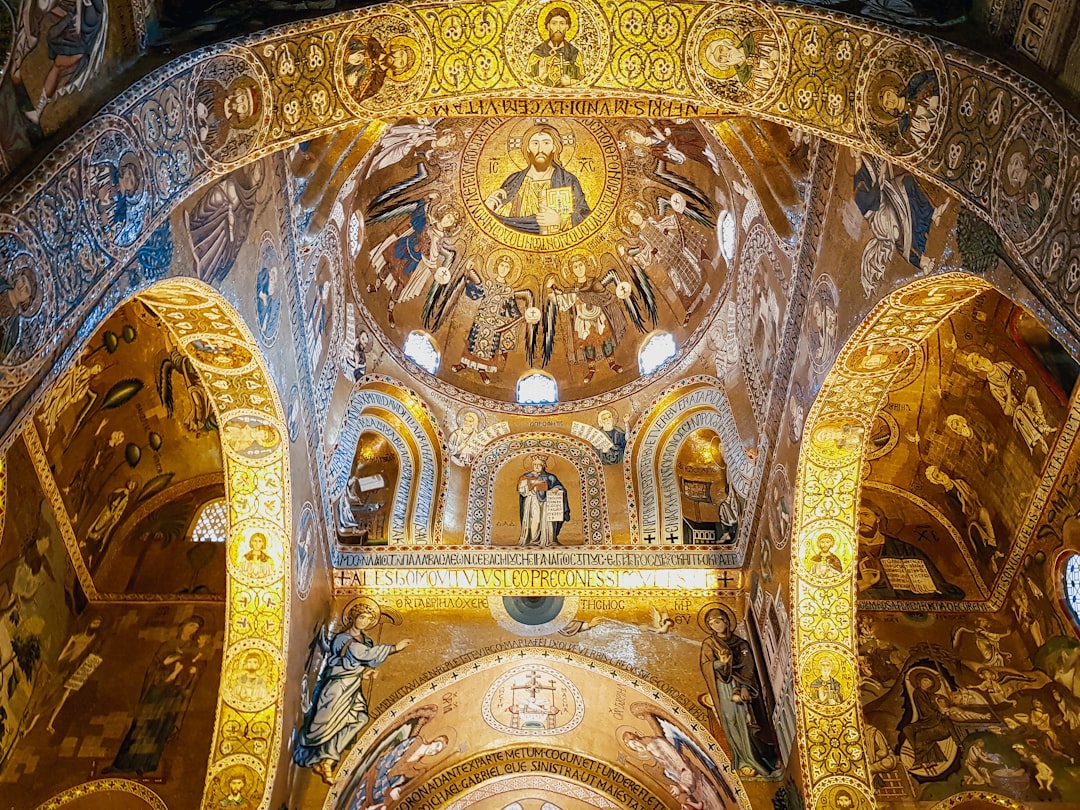
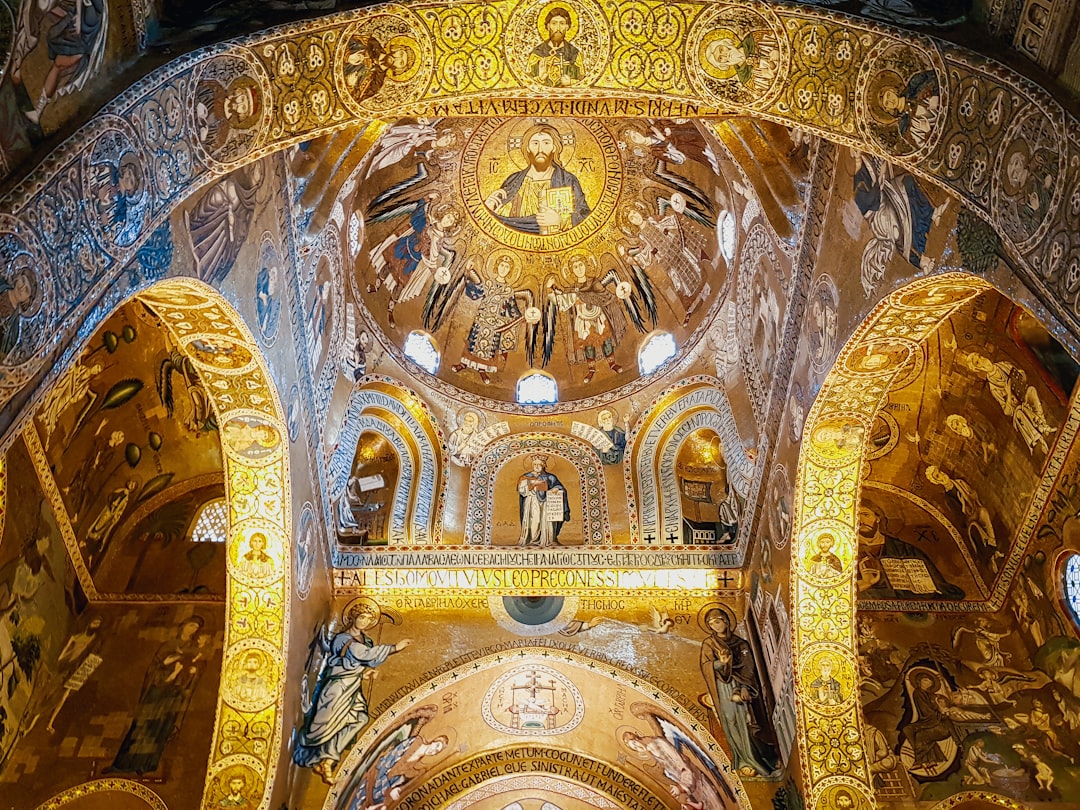
The Cappella Palatina in Palermo is one of the most disorienting architectural experiences in Europe. It is a chapel — relatively small, built between 1132 and 1143 for the Norman king Roger II of Sicily — that contains three complete and fully realised architectural vocabularies simultaneously. The ceiling is a muqarnas ceiling, a honeycombed wooden structure of distinctly Islamic character, decorated with paintings that depict a royal court in the style of Fatimid Egypt. Below it, the walls are covered in Byzantine mosaics of the highest quality — gold backgrounds, severe frontal figures, Greek inscriptions. The floor and the lower walls are in marble inlay work of Cosmatesque design, the technique developed in Rome for Christian church decoration. The arch forms are partly Norman, partly pointed in the Arab manner. The building was designed by craftsmen of three different cultures working simultaneously on a single commission. (See also: Noto)
This is not a synthesis achieved by compromise or ignorance. Roger II’s court was genuinely multilingual and multicultural — he spoke Arabic and Greek, maintained Arab geographers at his court (the cartographer al-Idrisi produced his world map in Palermo, dedicated to Roger, in 1154), and administered a kingdom whose population was majority Arabic-speaking. The Norman conquest of Sicily from the Arabs, completed in 1072, was a military takeover of a sophisticated Islamic state. The Normans did not destroy what they found; they appropriated it.
The Buildings of the Arab-Norman Kingdom
UNESCO inscribed the Arab-Norman monuments of Palermo and the surrounding area as a World Heritage Site in 2015, under the designation “Arab-Norman Palermo and the Cathedral Churches of Cefalù and Monreale.” The inscription covered nine monuments in total: in Palermo, the Cappella Palatina, the Church of San Giovanni degli Eremiti, the Church of Santa Maria dell’Ammiraglio (the Martorana), the Church of San Cataldo, and the Palazzo della Zisa; the Cathedral of Palermo; and the cathedrals of Cefalù and Monreale, the latter two outside the city.
The Cathedral of Monreale, seventeen kilometres south of Palermo in the hills above the Conca d’Oro, contains the largest and most complete cycle of Byzantine mosaics in the world outside Ravenna — 6,340 square metres of gold and glass mosaic covering nearly every surface of the nave, aisles, and apse. The creation of this mosaic programme, between approximately 1174 and 1185, required a workforce of craftsmen whose size has been estimated in the hundreds. The subject matter follows a unified theological programme from the Old Testament in the nave to the New Testament in the transept to the figure of Christ Pantocrator in the apse — but the style is not entirely consistent, reflecting the different workshops and sources from which the craftsmen were drawn.
What the Legacy Tells Us
The Arab-Norman kingdom of Sicily lasted less than a century and a half — from the Norman conquest of 1072 to the accession of the German Hohenstaufen dynasty in 1197. Its cultural synthesis was dismantled under subsequent rulers who had less tolerance for religious and cultural plurality. The mosques were converted or demolished; the Arab administrative system was gradually replaced. The buildings survived because stone is hard to destroy and useful once built.
What the buildings record is a moment when the three great civilisations of the medieval Mediterranean — Islamic, Byzantine, and Western European — existed in a single polity and found, however briefly and under the specific conditions of Norman pragmatism, a way to produce something together that none of them could have made alone. The honeycombed muqarnas ceiling of the Cappella Palatina is the most eloquent evidence available that multicultural synthesis is not a modern concept invented in European universities, but a historical phenomenon with its own monuments.