The Italian Sunday lunch is not a meal. It is a ceremony, a weekly institution, a recurring gathering that structures the rhythm of Italian family life and that exists at a different register of time and significance from every other meal of the week. It is longer, more elaborate, more socially demanding, more food-intensive, and more emotionally freighted than any weekday eating occasion. In many Italian families, it is the event around which the week is organised: the lunch itself may last four hours, the preparation may begin on Saturday, and the occasion’s social obligations — who sits where, who brings what, whether the nonna’s ragù will be judged adequate or not — are part of a complex family politics that the meal simultaneously enacts and resolves.
The Sunday lunch has been, throughout the post-war period of Italian history, the primary expression of the family as a social unit. The meal gathered not just the nuclear family but the extended family — grandparents, uncles, aunts, cousins, partners, and children — at a table that was too large for the apartment and that required the auxiliary chairs and the extra table from the neighbour. It was cooked by the nonna, the grandmother, or by the matriarch of the family, and the cooking began early in the morning. The specific dishes — the ragù that had simmered since eight, the handmade pasta, the roast meat, the vegetables, the dessert — were matters of family tradition and individual skill, and they were judged, respectfully but thoroughly, by the assembled family.
The Structure of the Meal
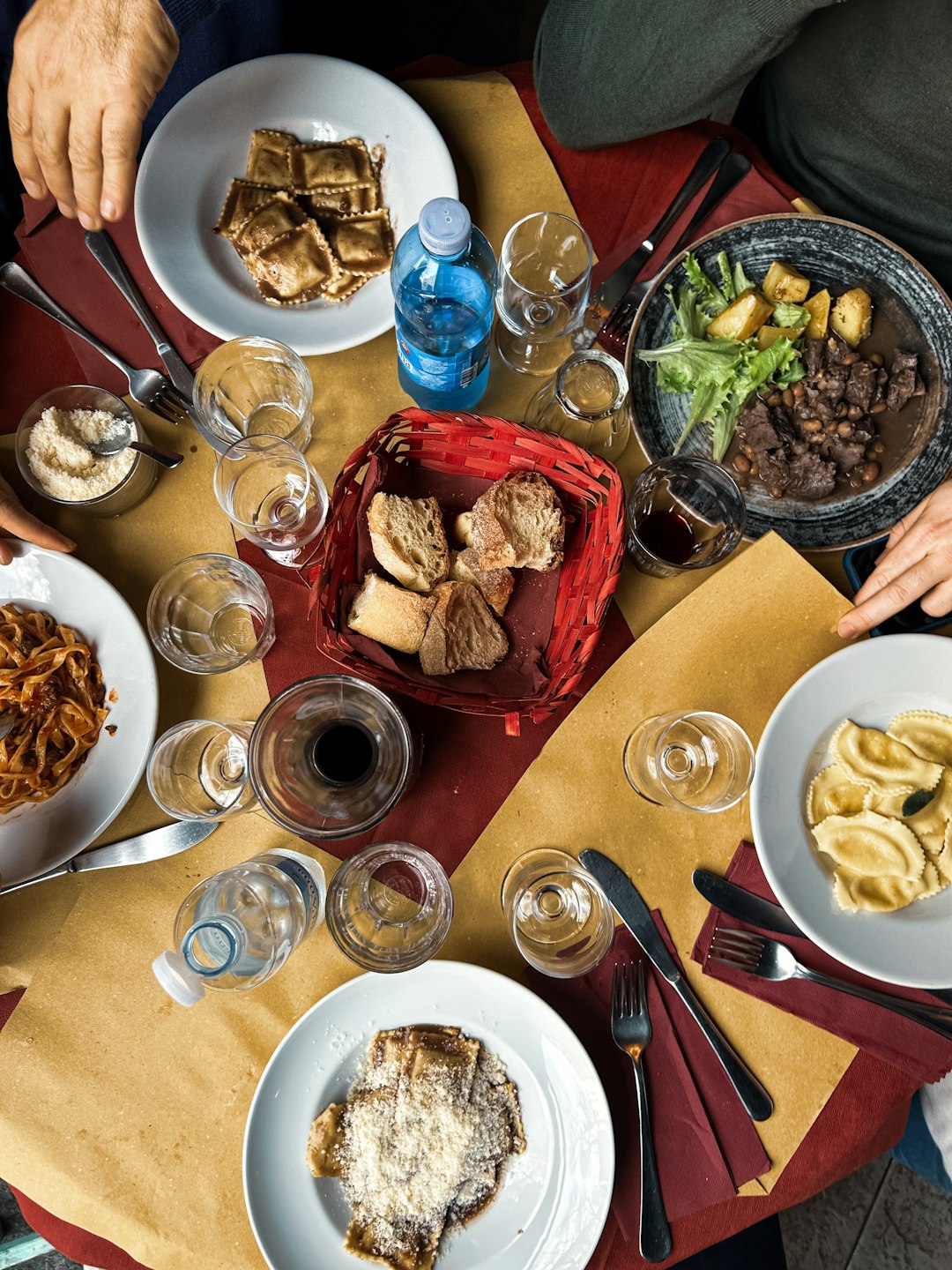
The Italian Sunday lunch has a structure that reflects the full Italian ceremonial meal — the sequence of courses that distinguishes the Italian dining tradition from the single-plate cultures of northern Europe and North America. The antipasto is the beginning: cold cuts and salumi, perhaps a frittata, bruschette, olives, artichokes under oil, whatever the season and the region provide. The antipasto at a Sunday lunch is abundant enough to be a meal in itself; it is intended to stimulate the appetite and the conversation, and its abundance is part of the hospitality gesture.
The primo — the first course of pasta, risotto, soup, or gnocchi — is the centrepiece of the Sunday lunch in most of Italy. This is where the ragù appears, where the handmade pasta demonstrates the cook’s skill, where the regional identity of the family’s food tradition is most clearly expressed. In Bologna, the primo is tagliatelle al ragù — the genuine Bolognese, made with a mixture of beef and pork slowly cooked in wine and soffritto, served with fresh egg tagliatelle. In Naples, it is maccheroni al ragù napoletano — the Neapolitan Sunday ragù, which includes the meat (braciole, sausage, and pork ribs) as both the flavouring for the sauce and the source of the secondo. In Sicily, it is pasta al forno — baked pasta with meat sauce, ricotta, and hard-boiled eggs, assembled in a timbale and brought to the table whole. Each region has its specific Sunday primo, and the visiting outsider who has the good fortune to be invited to a Sunday lunch will encounter this in its most authentic and unrepeatable form.
The secondo — the main course of meat, fish, or vegetable — follows. For Sunday lunch, the secondo is typically more elaborate than the weekday version: a roast (arrosto), a slow-braised meat (stracotto, brasato, spezzatino), a whole roasted chicken or rabbit, or in coastal areas a whole baked or grilled fish. The roast meat of the Sunday lunch, cooked in the oven alongside potatoes and vegetables, filling the apartment with the smell that has become, for Italians who grew up with it, the olfactory code for Sunday itself, is one of the great constants of Italian domestic life.
The Ragù: At the Heart of Sunday
The ragù — the meat sauce, simmered over several hours until the meat has dissolved into the tomato base and the fat has risen and been skimmed and the whole thing has achieved a density and complexity that quick cooking cannot produce — is the single most important element of the Italian Sunday lunch in the regions where it is made (the south, the Po Valley, parts of Tuscany), and the question of whose ragù is better — the mother’s or the mother-in-law’s — is among the more fraught Italian family arguments. The word ragù comes from the French ragoût (a slow-cooked meat stew), but the Italian versions have developed over two centuries into something that has no real French equivalent in character.
The Bolognese ragù — the one most internationally known — is a relatively restrained preparation: finely chopped beef and pork (in the original, always both meats), soffritto of onion, celery, and carrot, a glass of white wine reduced, then milk or cream in the Bolognese tradition, then tomato in small quantities, and a long, patient simmering. The result is a dense, unctuous sauce in which the meat is present not as chunks but as a flavouring element distributed throughout the sauce. The correct pasta for this ragù is tagliatelle — wide, egg-based pasta — not spaghetti, which the Bolognese consider a category error of almost comic proportion.
The Neapolitan ragù is a different creature: the sauce is tomato-forward, deeply coloured, and cooked with large pieces of meat (braciole — rolled and stuffed beef — alongside pork ribs and sausage) that are removed before serving and eaten as the secondo. The pasta bathed in this sauce acquires a red intensity and a richness that the Bolognese version achieves differently. Both are extraordinary preparations in their best forms; both require the specific conditions of the Sunday — the time, the occasion, the family gathering — to make complete sense.

The Wine of Sunday
The Sunday lunch is also the occasion on which wine is taken seriously in a way that weekday meals, for most Italian families, do not permit. The bottle brought out for Sunday is not the everyday house wine but something considered: perhaps a bottle from the local producer that the family has been buying for years, perhaps a regional wine of some age that has been kept for the occasion. The ritual of opening a good bottle, of pouring it properly, of attending to how it changes through the meal — these are part of the Sunday lunch’s ceremony.
Regional wine culture is most clearly visible at the Sunday table: in Piedmont, the Sunday lunch is accompanied by Barolo or Barbera d’Asti, depending on the occasion; in Tuscany, by Chianti Classico or Brunello; in the Veneto, by Amarone or Valpolicella; in Campania, by Aglianico or Greco di Tufo. The connection between the local wine and the local food — the Bolognese ragù and the Sangiovese that cuts through its richness, the Neapolitan tomato-based dishes and the Aglianico that has the acidity to match them — is not arbitrary: it has developed over centuries of shared table culture, and the rightness of the pairing is intuitive rather than theoretical to the people who grew up with it.
The Contorno, the Dessert, the Digestivo
The contorno — the vegetable side dish, served alongside or after the secondo — is determined by season: the spring Sunday lunch might feature asparagus or artichokes, the autumn one roasted porcini mushrooms or braised fennel, the winter one winter squash or broccoli rape. The contorno is cooked simply — olive oil, garlic, salt, and the specific vegetable — and its function is to provide freshness and vegetable matter in a meal that is otherwise meat-forward. Italian vegetable cookery at its best is displayed not in elaborate preparation but in the quality of the ingredient and the simplicity of the treatment.
The dessert of the Sunday lunch is where the family’s pastry tradition is expressed. The torta della nonna — the custard-filled short-pastry tart, covered with pine nuts and dusted with powdered sugar, that appears on Sunday tables throughout central Italy — is the universal expression of home-baked pastry at a level of competence and care that distinguishes it from the pastry shop version. In Sicily, the cassata — the layered ricotta, marzipan, and sponge cake decorated with candied fruit — is the Sunday dessert par excellence. In the Veneto, the tiramisu, made with the proper Savoiardo biscuits and the proper mascarpone and the proper dose of coffee and Marsala, is what appears at the end of Sunday lunch in the families that maintain the tradition.
After the dessert — after the fruit that sometimes follows it, after the coffee — comes the digestivo: the grappa or amaro that is the traditional closing gesture of the Italian meal. The Fernet-Branca, the Amaro Montenegro, the Cynar, the local herb-based liqueur that every region has its own version of — these are drunk in small quantities, more as symbolic than as functional elements of the meal’s end, signalling that the eating portion of the afternoon has concluded and the conversation portion may now proceed.
Sunday Lunch and the Visitor
The Sunday lunch is, for the visitor, the Italian institution most difficult to access from the outside and most rewarding when access is achieved. Restaurants that offer a serious Sunday lunch — a genuine multi-course Italian meal with a handmade pasta primo and a properly cooked main course and a house dessert — exist throughout Italy, but the best Sunday lunch experience is a domestic one, and arriving at it requires either an Italian friend who has extended an invitation or an agriturismo stay, which often includes the Sunday lunch as part of the farm’s hospitality offering.
The agriturismo Sunday lunch — conducted in a farmhouse dining room, with the farm’s own products (olive oil, wine, vegetables, sometimes the pork or lamb from the farm’s own animals) appearing at every course — is the version of the Italian Sunday lunch most accessible to the visitor without Italian family connections. The quality varies: the best agriturismi offer a Sunday table that genuinely reflects the local food tradition and the quality of the farm’s own produce; the more commercially oriented ones serve a standardised tourist version of the meal. Distinguishing between them requires the same research that distinguishes any good restaurant from a mediocre one: look for farms that are serious about their agricultural production as well as their hospitality, that have been in operation for long enough to have developed their kitchen, and that are recommended by people who have eaten there.

The Changing Sunday Lunch
The Italian Sunday lunch, like many Italian institutions, is changing under the pressure of social transformation. The extended family gathered at the nonna’s table — the model that defined the tradition through the postwar decades — is less common than it was, partly because Italian families are smaller, partly because Italian women (who historically cooked the Sunday lunch) have professional lives that make four-hour cooking sessions less available, and partly because the social mobility of the past generation has scattered the extended family across cities and regions in a way that makes the weekly gathering impossible to maintain.
The Sunday lunch persists, however, in modified forms. The restaurant Sunday lunch — a table booked for two or three hours, a menu that reflects the traditional structure without requiring anyone to cook it — is a significant part of the Italian restaurant economy; the trattorias and osterias that cater specifically to Sunday family groups, with set menus, house wines, and tolerant attitudes toward children, do a substantial proportion of their annual business on Sunday afternoons. The Sunday barbecue — the grigliata of meats and vegetables, conducted in the garden of a house or a country restaurant, with the same social function as the traditional Sunday lunch but a different mode of cooking and a less formal structure — is the summer version of the institution in the regions where outdoor space makes it possible. And the tradition of the family gathering, the multi-generation table, the meal as a social ceremony, persists even as the specific form it takes continues to evolve.