Procida is the smallest of the inhabited islands in the Gulf of Naples, and for most of the twentieth century it was also the least visited — a working island, a fishing island, an island where the bright stacked facades of the Marina Corricella served as background rather than destination. Ischia was bigger and had the thermal waters. Capri had the legend and the international reputation. Procida had the boats and the lemon trees and the particular quality of a place that had not adjusted itself to external expectations because the external expectations had not arrived in sufficient force to require adjustment.
That equilibrium has shifted. The designation of Procida as the Italian Capital of Culture for 2022 — a government programme that rotates annually to different smaller Italian cities and cultural territories — gave the island an international profile it had not previously had. The visitors who came for the designation year found what they came for: an exceptionally photogenic fishing town, a food culture built on the produce of the sea and the island’s famous lemons, and a social fabric that remained, despite the attention, substantially oriented toward the needs of the people who lived there rather than those who had come to look at it. Whether that balance will survive sustained tourism pressure is a genuine question. For now, the island retains what made it interesting in the first place, and visiting it requires the effort of a boat journey from Naples that continues to act as a natural filter on mass tourism.

The Island and Its Form
Procida is volcanic in origin — the same volcanic system that produced Ischia and the Phlegrean Fields on the mainland — and small enough that the entire island can be walked in a long morning: approximately four kilometres at its longest point, with an area of just over four square kilometres. The population, around ten thousand people, lives at a density that gives the island its characteristic urban quality: this is not countryside with villages but a genuine urban settlement that happens to be surrounded by sea.
The island has several distinct zones. The Marina Grande (or Sancio Cattolico) is the main port and the most utilitarian part of the island — ferries and hydrofoils from Naples and Pozzuoli arrive here, and the quayside has the practical character of a working harbour. Terra Murata, the fortified medieval settlement on the island’s highest point, is the oldest and most historically significant part of Procida: the walls, the Abbey of San Michele Arcangelo (patron of the island), and the former Bourbon prison that occupies a commanding position over the northern sea face constitute an ensemble that has survived relatively intact because the difficulties of the site have discouraged redevelopment.
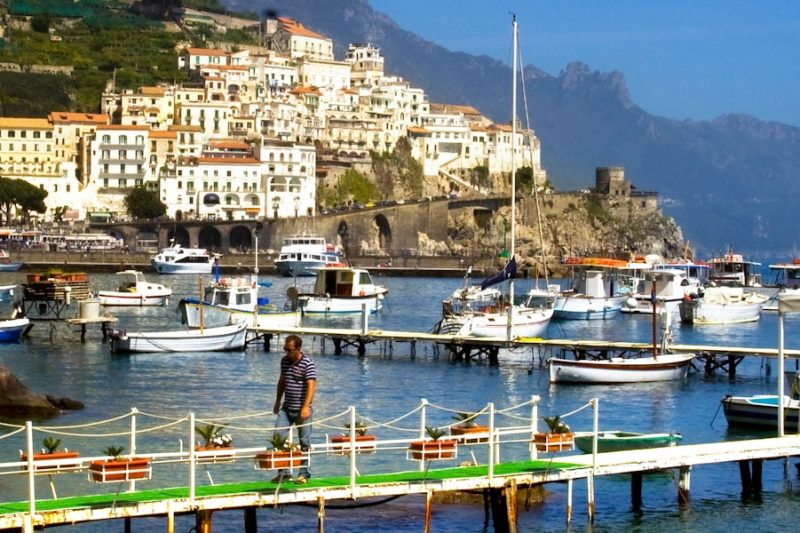
Marina Corricella is the part of the island that has become its photographic signature: a crescent of fishing harbour with coloured facades stacked three and four storeys above the water, each house in the particular palette of ochres, terracottas, yellows, and faded greens that characterise the vernacular architecture of the Campanian coast. The houses face the sea — the back streets are a labyrinth of vaulted passages and exterior staircases — and the fishing boats moored at the quay complete a composition that seems almost too well-arranged to be accidental. It is not arranged: this is simply what a fishing community building on a steep and rocky harbour looks like when it has been building there for four hundred years.
Terra Murata: The Medieval Core
The fortified settlement on the highest point of the island predates the fishing towns below it by centuries. The walls were built and rebuilt by successive Mediterranean powers — Aragonese, Bourbon, and earlier — who recognised the strategic value of a fortified position controlling the approaches to the Gulf of Naples. The Abbey of San Michele, whose church contains a sequence of paintings by local and Neapolitan artists of the 17th and 18th centuries including a dramatic Michael the Archangel attributed to Luca Giordano, is still an active religious institution. The church is open at restricted hours and the painting collection, though not systematically catalogued, is of genuine quality.
The former Palazzo d’Avalos — the Bourbon prison that stands at the edge of Terra Murata, visible from the sea as a dominant and slightly oppressive presence above the coloured houses below — has been subject to repeated conversion proposals and remains unoccupied. Its presence in the landscape is partly what gives Terra Murata its particular atmosphere: a medieval fortified settlement crowned by the imposing mass of an 18th-century prison is not a typical heritage ensemble, and the visual relationship between the two — the layers of institutional power, each replacing the last — reads clearly in the landscape.

The Lemons and the Agricultural Interior
The interior of Procida — the area between the Marina Grande and the agricultural zone around the Chiaiolella lagoon at the southern end of the island — is one of the more surprising aspects of a place usually encountered through its waterfront. The island has a working agricultural tradition based primarily on the cultivation of lemons, specifically the Limone di Procida: a large, thick-skinned variety with a highly fragrant rind and an intensely acidic juice that the local food culture uses with a freedom that reflects centuries of abundance.
The lemon gardens are found between and behind the houses of the interior — climbing up garden walls, overhanging lanes, filling spaces between residential buildings with a density of cultivation that is both productive and visually striking. The scent of lemon blossom in spring is the most characteristic olfactory experience of the island, and it permeates the residential streets in a way that the waterfront, with its fish and diesel, does not.
The island’s lemon appears in several specifically Procidan preparations: limoncello (as elsewhere in the Campanian coast, though the local version uses the thick rind of the Procidan lemon for a more intense flavour), lemon-flavoured pasta, the pasta e limone prepared in the local restaurants with a simplicity that requires the quality of the lemon to do all the work, and the lemon-stuffed sfogliatella variants that appear in the island bakeries.
The Food: An Island Cuisine
The cuisine of Procida is the cuisine of an island fishing community with a lemon obsession and a Neapolitan culinary inheritance. The fish caught in the Gulf — orata (sea bream), branzino (sea bass), polpo (octopus), calamar, the various shellfish — arrive at the waterfront directly from the boats and appear in the restaurants with a freshness that the mainland cannot easily replicate. The preparation is simple: grilling over wood, steaming, baking with olive oil and local herbs, the occasional pasta sauce.
The pasta preparation most associated with the island is spaghetti alla Procidana — spaghetti with a sauce of calamar, tomato, olives, capers, and Procidan lemon juice, combining the marine and citrus elements of the island’s economy in a single dish. The execution varies between restaurants, and the versions that use the best-quality calamar and the freshest lemon produce a result that belongs to the category of simple food elevated by its ingredients to something considerably more interesting than its technique would suggest.
The island bakeries produce the graffe — the fried dough rings sprinkled with sugar that are a Neapolitan carnival tradition but available in Procida year-round — and the lemon-filled pastry variations that make the island’s pasticcerie a destination in their own right. Eating a warm graffe from a paper bag on the quay at the Marina Corricella, watching the boats and the coloured houses in the morning light, is an experience that resists the kind of analytical description applied to formal restaurant meals and simply asks to be had.
Where to Eat
The restaurants of Marina Corricella, built into the lower levels of the stacked harbour houses, have the most dramatic setting and the most visible presence to arriving visitors. The quality varies — the locations that depend on the photogenic backdrop for their customers are not always the most serious about the food. The restaurants on the road between Terra Murata and the interior, and the osterie around the Marina Grande that serve the local population rather than primarily the visitors, tend to be more reliable. A full meal with local wine costs between €25-40 per person at a good local restaurant; the tourist-oriented establishments on the prime waterfront positions command higher prices for average quality.

The Water and the Beaches
Procida’s beaches — the Chiaiolella on the south side, the smaller Ciraccio and Ciracciello — have the clear water of an island that has not been subjected to the development pressure that has affected Ischia and Capri. The Chiaiolella area, at the southern end of the island, has a calmer, more sheltered character than the open sea face to the north, and in summer it functions as the primary swimming destination for island residents and visitors alike. The access to the beaches is either on foot or by the island’s small buses.
Swimming from the rocks at the base of Terra Murata — accessible by a path from the fortified town above — is the most dramatically situated swimming on the island: the cliff face drops directly into clear blue water, the walls of the medieval town are above, and the boats pass at a respectful distance. The water temperature in the Gulf of Naples makes sea swimming comfortable from late May through October.
Getting There and the Rhythm of the Island
Procida is reached by ferry from Naples (Calata Porta di Massa, the main ferry terminal) or from Pozzuoli on the northern side of the Phlegrean Fields peninsula. The fast hydrofoil service takes approximately 35-40 minutes from Naples; the slower car ferry takes longer. Frequency varies by season — in summer, services run throughout the day; in winter, they are less frequent but the island remains accessible.
The island’s internal transport is a combination of the island bus network, scooter and bicycle rental, and walking. The scale of Procida makes walking the primary means of getting around: from the ferry at Marina Grande to Marina Corricella is a ten-minute walk over the hill, and from the Corricella to Terra Murata is another fifteen minutes upward. The island is compact enough that no destination is more than thirty minutes on foot from any other.
The optimal season is May to June and September to October. July and August bring Italian domestic tourists in significant numbers and the accommodation on the island books out well in advance. The island in the low season — October through April, excluding the Easter period when it is traditionally busy — has a quality of working-island life that is inaccessible in summer: the restaurants cater primarily to residents, the piazzas have their habitual users rather than visitors, and the boats are for fishing rather than for tourism.
Accommodation on the island ranges from small guesthouses and B&Bs in the residential fabric to a handful of hotel-standard establishments. The options are fewer and less luxurious than Capri or Ischia, which reflects both the island’s smaller scale and its historical disinterest in the luxury end of the tourism market. This will change; it is changing. The time to visit Procida is before that change is complete.