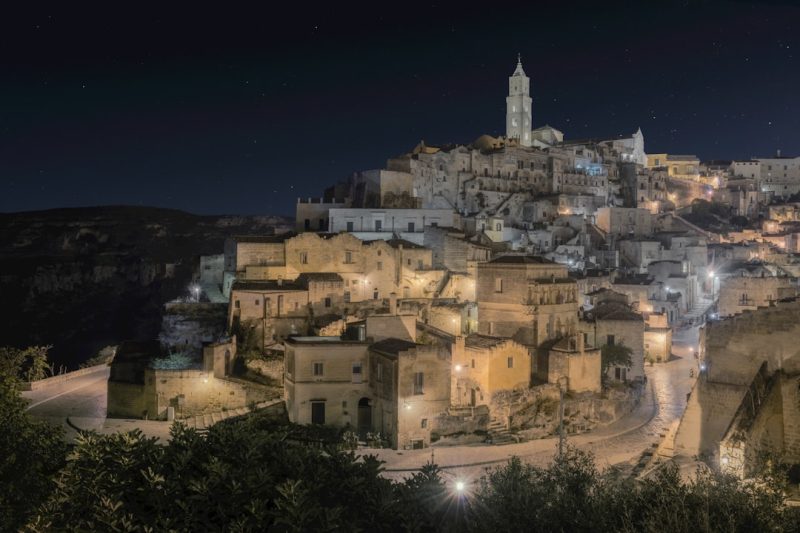
Orvieto occupies a mesa of volcanic tufa rising 325 metres from the valley of the Paglia river in southern Umbria, and its position — sudden, vertical, improbable — has the quality of a geological event rather than a human decision. The Etruscans settled the mesa in the 9th century BCE and called it Velzna; the Romans destroyed it in 264 BCE and it was not significantly resettled until the medieval period, when it became one of the principal towns of the Papal States. The cathedral, begun in 1290 and worked on by successive architects and craftsmen for three centuries, is acknowledged as one of the finest Gothic buildings in Italy. These things — the tufa mesa, the Etruscan history, the cathedral — constitute the official Orvieto, the one that appears in the guidebooks and justifies the day trips from Rome.
What lies beneath this official version is another city entirely. The volcanic tufa of the mesa has been carved continuously for at least 2,500 years, producing a network of tunnels, caves, cellars, wells, cisterns, olive oil presses, and dovecotes that extends beneath the entire surface of the town in a density that only systematic excavation has begun to reveal. Orvieto Underground — the official name of the tour program that provides access to sections of this subterranean city — offers a version of the town that the cathedral and the Etruscan Museum above it cannot: the physical record of the quotidian life of a city over two and a half millennia, carved into the rock that supports everything above it.
The Geological Foundation: Tufa and What It Permits
The tufa of Orvieto’s mesa is a specific type of volcanic rock — the product of the eruption of the Vulsini volcanic complex, the same system that formed the Lago di Bolsena to the south — and it has properties that make it uniquely suitable for the kind of subsurface excavation that produced the underground city. The tufa is soft enough to cut with relatively simple tools (the Etruscans used iron picks and wooden wedges), resistant enough to maintain the shape of cut spaces without collapse, and stable enough in humidity and temperature to preserve organic materials — wood, textile, food — in excavated spaces.
The practical consequences of these properties are visible throughout the underground: the walls of the excavated chambers and tunnels have the smooth, curved surfaces of a material that was cut rather than built, and the cuts made by Etruscan tools in the 5th century BCE are still visible on surfaces that have been sealed from the open air since that time. The continuity of human use of these spaces — from the Etruscans through the Romans, medieval, Renaissance, and early modern periods — means that each stratum of use is physically present in the geology, the earlier cuts visible beneath or alongside the later additions.
The Underground Tour: What You See
The guided tour offered by Orvieto Underground enters the subsurface city from access points in the historic centre and takes approximately an hour. The spaces visited include Etruscan cisterns and wells, medieval olive oil presses, dovecotes (pigeon breeding was an important food production activity in the medieval period, and Orvieto’s underground contains some of the largest underground dovecote installations in central Italy), storage cellars from various periods, and sections of tunnel that connected different parts of the underground network.
The Etruscan cisterns are among the oldest surviving elements: large, carefully cut storage chambers with the characteristic tapered form of Etruscan hydraulic engineering, designed to maintain the water pressure needed to bring the contents to the surface by simple physics rather than mechanical pumping. The scale of the cisterns — some several metres in diameter, cut to depths of 10-15 metres into the tufa — gives some sense of the engineering capability of the Etruscan city above, whose population required a reliable water supply in a mesa situation where surface water was unavailable.
The medieval olive oil presses are a different kind of revelation: complete industrial installations carved into the rock, with the stone-cut channels that directed the oil from the press into collection chambers, the rings cut into the tufa for fixing the press mechanism, and the storage jars (dolia) still in position in the floor. The underground temperature — constant at around 14°C regardless of the season — made these spaces ideal for oil storage, and the presses remained in use into the early modern period. The continuity of use across fifteen centuries of the same basic industrial installation is one of the more striking things that the underground demonstrates.
The Pozzo di San Patrizio: Engineering Above and Below
The Pozzo di San Patrizio — the well commissioned by Pope Clement VII in 1527 and designed by Antonio da Sangallo the Younger — is one of the more extraordinary engineering solutions in Renaissance Italy. The well descends 53 metres to the water table, and its shaft is surrounded by a double helix of staircases (one descending, one ascending) that allowed donkeys carrying water up to pass those carrying empty containers down without encountering each other — a practical solution to the logistical problem of supplying a hilltop city with water in a period before mechanical pumps.
The well is lit from the central shaft, and descending one staircase while looking across the open centre to the opposing staircase produces a view that is both architecturally beautiful and geometrically vertiginous: the two spirals of stairs corkscrewing downward around the central void, the light diminishing with depth, the water surface visible far below. The engineering is as elegant as anything Sangallo produced above ground, and the relationship between the Renaissance technical solution and the Etruscan cisterns visible in the underground tour below provides a chronological bracket for the two and a half thousand years of subsurface engineering in Orvieto.
The Cathedral: The Official Version
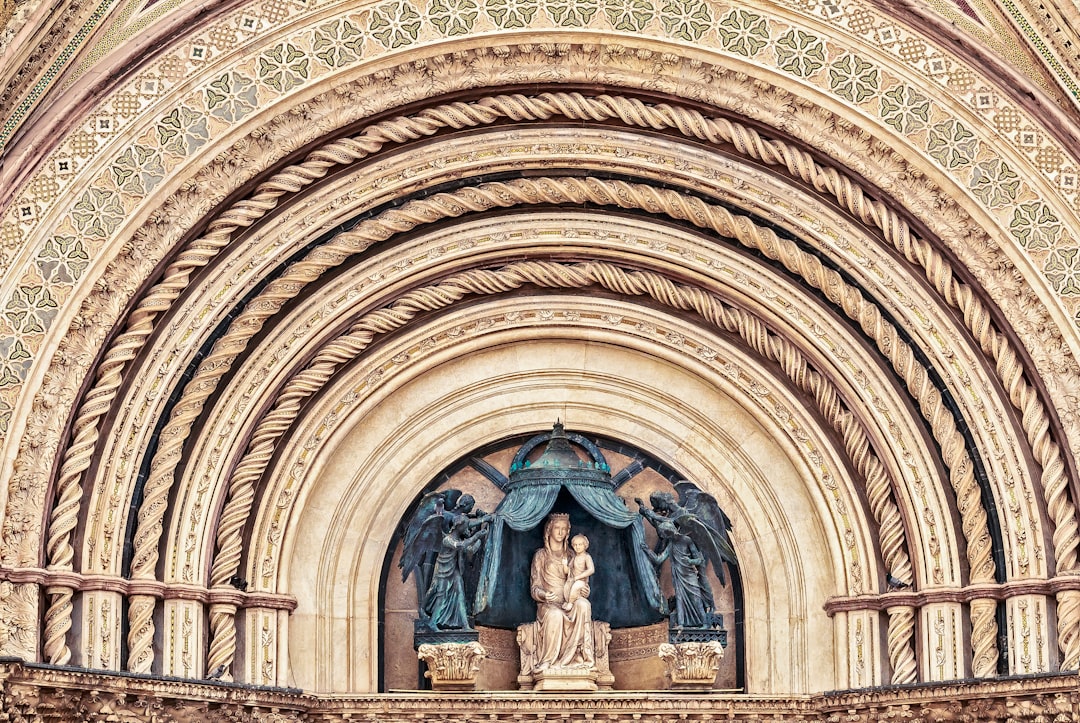
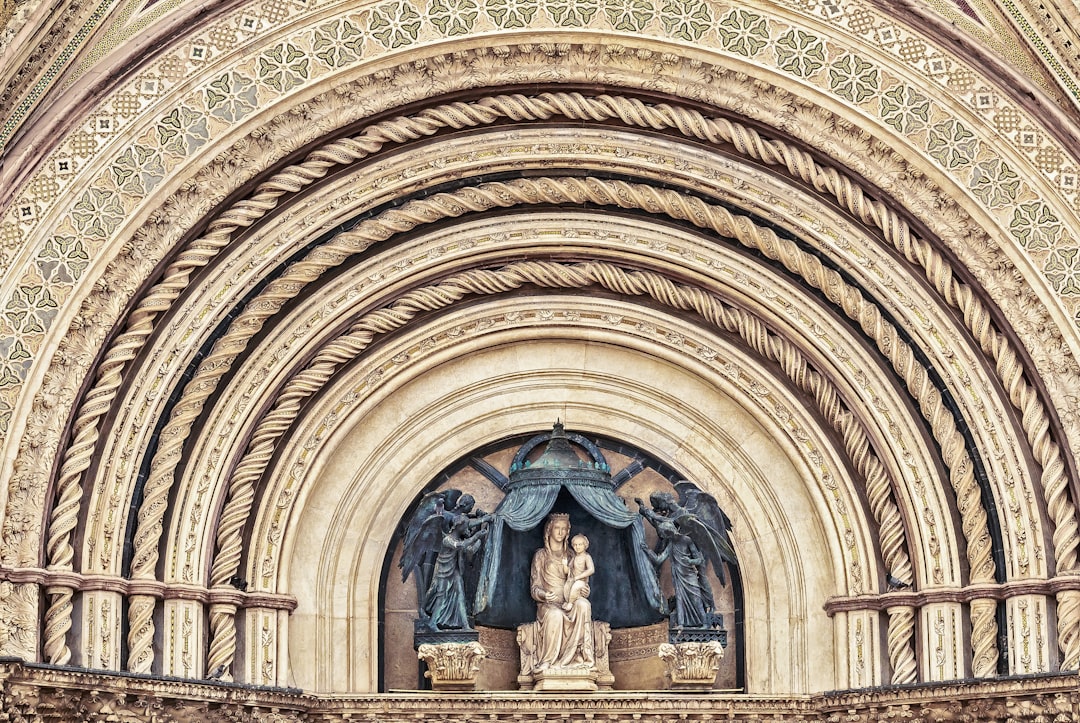
The Cathedral of Orvieto — the Duomo — is the reason most visitors come, and the reason is justified: the facade, designed primarily by Lorenzo Maitani in the 14th century and worked on subsequently by numerous hands, is one of the most complete and ambitious Gothic-era decorative programmes in existence. The bronze reliefs on the pilasters at the base of the facade depict scenes from the Old and New Testaments with a narrative density and sculptural quality that rewards extended examination rather than the brief inspection that a tour stop typically allows.
The Cappella di San Brizio inside the cathedral contains the fresco cycle commissioned from Luca Signorelli in 1499 — the depiction of the Last Judgement, the Anti-Christ, the Resurrection of the Dead — that Michelangelo is documented to have studied before beginning the Sistine Chapel ceiling. The figures of Signorelli’s resurrecting dead — muscular, contorted, climbing from the ground with an energy that anticipates the Sistine by eight years — are among the most powerful images of the 15th century and the primary reason, alongside the underground, to spend more than a single day in Orvieto.
The Wine: Orvieto DOC
Orvieto Classico — the white wine produced from the DOC zone surrounding the town, primarily from Grechetto, Trebbiano Toscano, and other local varieties — is one of the oldest named Italian wines, with a documented history of production stretching back to the medieval papacy. The wine was for centuries a sweet or semi-sweet product (abboccato) that reflected the natural tendency of the local grapes to retain residual sugar, and the abboccato style is still produced by some of the traditional estates as the closest surviving expression of what medieval Orvieto wine tasted like.
The contemporary production has shifted largely to dry (secco) versions that are better suited to modern market preferences, and the quality of the best dry Orvieto Classico — particularly the Superiore wines from the volcanic soils immediately around the town — is considerably higher than the reputation of the denomination would suggest. The underground cellars of Orvieto were historically used for the ageing and storage of the wine, and visiting the underground spaces and then drinking the wine produced from the vineyards visible on the slopes below the mesa is one of the more satisfying continuities that Orvieto offers.
The Town Above Ground
The historic centre of Orvieto, reached from the valley by funicular railway (connected to the mainline station by a short underground people-mover), is compact and navigable on foot. The main street (the Corso Cavour) and the piazza in front of the cathedral are the primary public spaces. The medieval fabric of the residential areas off the main route — the narrow lanes, the occasional Romanesque church facade, the tufa used as building material in walls and foundations — provides the texture that the tourist-focused main street does not.
The food of Orvieto is southern Umbrian in character: pasta (umbricelli — a thick, rough-surfaced pasta specific to this part of Umbria), truffles (white from the San Giorgio valley in autumn, black from the Amerino hills through most of the year), freshwater fish from the Lago di Corbara immediately south of the town, wild game from the surrounding hills, and lentils from Castelluccio (further into Umbria but part of the regional food culture). The trattorie of the centre serve these products in preparations that reflect the Umbrian preference for simplicity and good materials over elaboration.
Expect to spend €20-35 per person for a full meal with wine in a good local restaurant. The wine list should include Orvieto Classico alongside the Umbrian reds (Sagrantino di Montefalco, Torgiano Rosso) that represent the other significant DOC zones of the region.
Practical Information
Orvieto is on the main Rome-Florence railway line and is served by Frecciarossa and regional trains — the journey from Rome is approximately 1.5 hours, from Florence approximately 2 hours. The station is in the valley below the town; the funicular railway (purchased with the same ticket as the bus system in town, or separately) provides the connection to the historic centre. The Orvieto Underground tours depart from the Piazza Duomo visitor office and run several times daily in the main season; booking in advance is advisable for weekend visits. The Pozzo di San Patrizio is a short walk from the funicular arrival point and has its own ticketing. The combination of the underground tour, the cathedral and Cappella di San Brizio, and the Pozzo constitutes a full day of engagement with the exceptional density of what Orvieto contains beneath and beside its official surface.