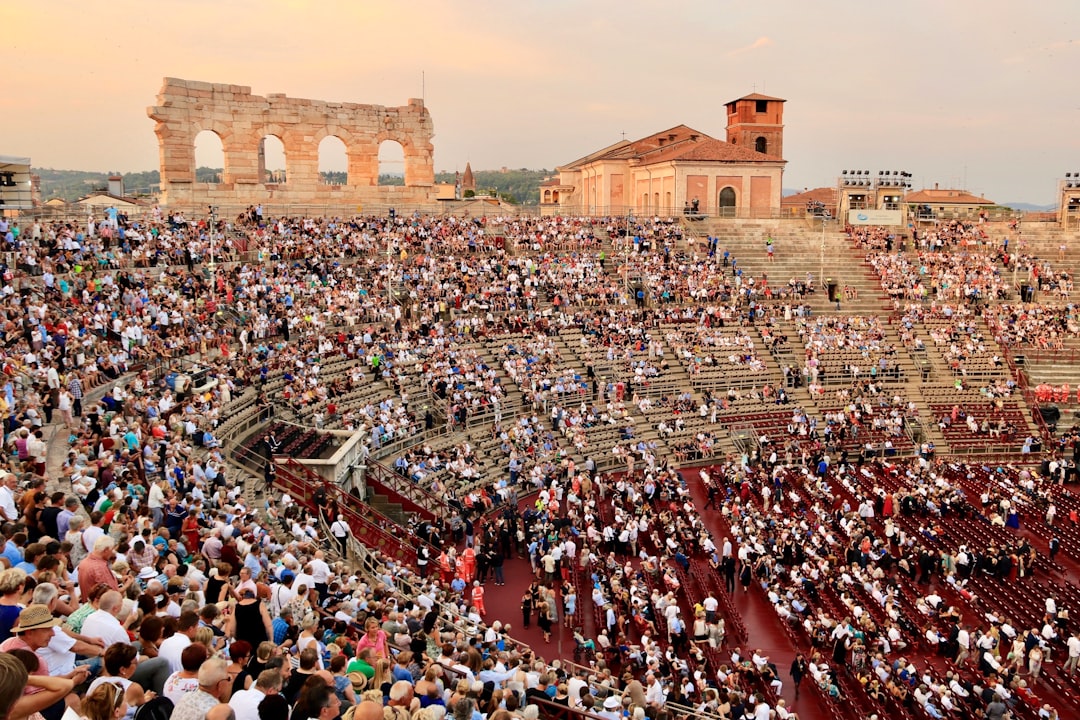
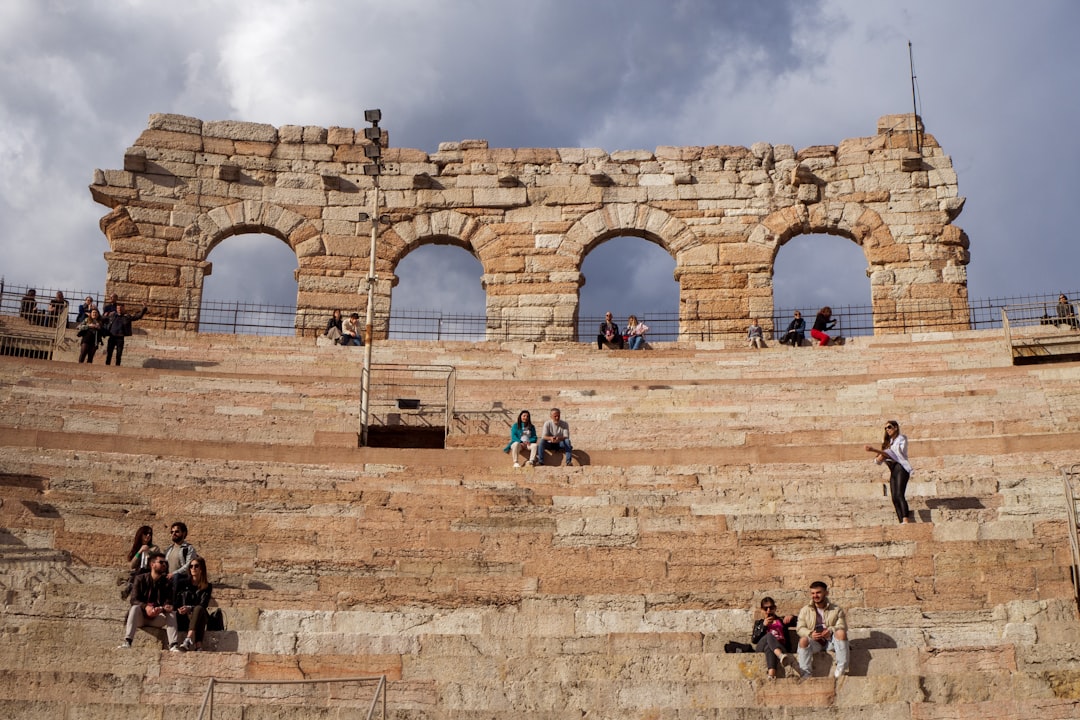
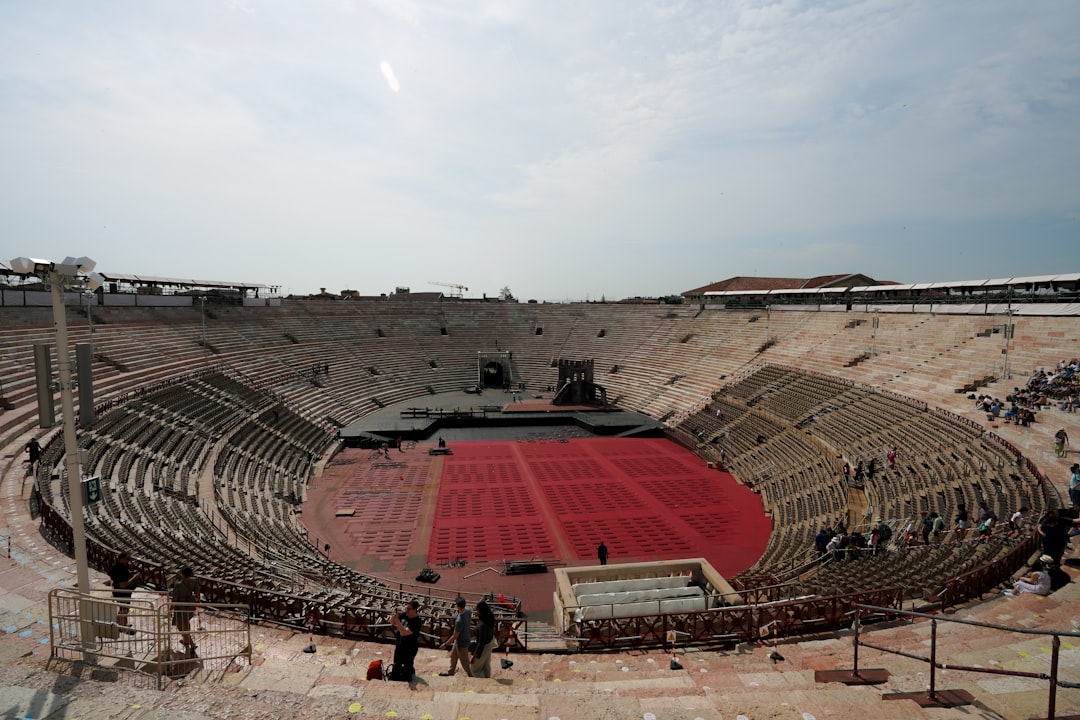
On a July night in Verona, fourteen thousand people settle onto Roman stone as the sun finishes setting behind the first-century limestone tiers of the Arena. Opera does not begin until nine. For an hour before that, the crowd arranges itself — numbered seats in the lower sections, unreserved stone steps above — and the amphitheatre becomes itself again: not a ruin or a monument but an occupied space doing exactly what it was built to do. The Arena di Verona is not the largest Roman amphitheatre in Italy — the Colosseum and the one at Capua are bigger — but it is the most intact, and the only one still used for mass public performance. The tiers rise 44 metres in a nearly perfect oval, built from Veronese limestone that has developed a warm grey patina over two thousand years. You can see the stage from every seat. Hearing it requires amplification — a concession to the physics of open air that the mathematics of sound makes unavoidable.
Opera has been performed in the Arena since 1913, when a celebration of the centenary of Verdi’s birth included a production of Aida that was attended, according to the newspapers of the time, by an audience that included significant portions of the Italian social and cultural establishment. The choice of Aida — with its spectacular staging demands, its crowd scenes, its elephants — established a template for Arena opera that has been maintained ever since. The programme favours large-scale works: Aida, Nabucco, La Traviata, Rigoletto, Turandot. The productions use the vast stage space — 73 metres wide at its broadest point — for staging that indoor theatres cannot accommodate.
The Experience of the Performance
Evening performances at the Arena begin at nine in the evening in June and July, when sunset has dimmed but not entirely eliminated the residual light. Before the performance begins, the audience is given small candles. When the house lights dim — or rather, when the sky darkens — 14,000 candles are lit simultaneously, creating a spectacle that lasts only a few minutes before the opening notes silence the crowd. It is one of the genuine theatrical rituals of Italian summer culture, and its effect on the atmosphere of the evening is disproportionate to its brevity.
The acoustics of an outdoor amphitheatre for opera are a legitimate concern. The Arena di Verona uses electronic amplification systems that balance the voices across the seating area, but the experience is different from an indoor performance in ways beyond mere volume. The lack of a ceiling means that the sound does not build and resonate in the way indoor acoustics allow. Some vocal subtleties are lost. The trade is the sky above the stage, which becomes part of the performance as the evening progresses — the first stars appearing during the second act, the full dark of an Italian summer night by the third.
 ancient amphitheater undergoing renovation with red seating area.” />
Practical Information
The Arena season runs from late June through early September. Tickets range from the relatively expensive numbered seats on the lower tiers (with seat cushion included) to the less expensive unreserved stone steps in the upper sections, where you bring your own cushion and arrive early enough to find a comfortable position. The stone steps are a genuinely good option if you are physically comfortable sitting on ancient Roman masonry for three hours; the view from the upper sections is panoramic and the social atmosphere around you is festive rather than formal.
Verona itself rewards a full day before or after the opera. The Roman city survives in unusually complete form: the Arena, the Teatro Romano on the opposite bank of the Adige, the Roman bridge, the archaeological excavations visible in the Piazza Bra. The medieval and Renaissance layers — the Scaligeri tombs, the Piazza delle Erbe with its market, the Castelvecchio — overlay the Roman substrate in a way that makes Verona one of the most historically legible cities in Italy. Romeo and Juliet’s purported balcony, on the Via Cappello, is fictional; the queue to photograph it is very much real.