Matera in daylight is already an exceptional place — the Sassi, the ancient cave city carved into the ravine of the Gravina river, is one of the most unusual urban landscapes in Europe, and the quality of the light on the limestone and tufa in the afternoon hours is extraordinary in the way that good stone and southern Italian light consistently are when they meet. But Matera at night is a different city: the same landscape illuminated by a system of artificial lights that has been designed with unusual care for a southern Italian town, and transformed by darkness from a documentary object — something to be understood in its historical complexity — into something more viscerally affecting.
The decision to illuminate the Sassi at night was not inevitable. Matera spent most of the 20th century embarrassed by the cave city: it was the symbol of southern Italian poverty, the place where the postwar Italian state found families living in caves with their livestock and identified it as a national shame requiring intervention. The forced relocation of the Sassi population between the 1950s and 1970s emptied the cave city and left it for decades as a depopulated ruin. The rehabilitation that has since occurred — UNESCO World Heritage inscription in 1993, tourism infrastructure development, the designation as European Capital of Culture for 2019 — has involved a conscious reframing of the Sassi from symbol of underdevelopment to expression of an extraordinary vernacular relationship between human habitation and geological form. The night illumination is part of this reframing, and it works.

The Sassi: Understanding the Structure
The Sassi consist of two adjacent districts — the Sasso Caveoso to the south and the Sasso Barisano to the north — separated by the ridge on which the old town (the Civita) sits. The Gravina ravine, whose walls the cave city covers on the Matera side, is visible from the upper town edges as a dramatic drop: the cliff face across the ravine, covered in cave openings, is the Murgia Materana nature reserve, and the interplay of the inhabited Sassi on one side and the uninhabited cave landscape on the other creates the visual field that defines the Matera experience.
The Sassi are not simply caves: they are a complex stratification of geological cavity, rock-cut habitation, medieval churches, Renaissance additions, baroque facades, and 20th-century construction, all integrated into a landscape where the boundaries between the natural and the built are deliberately obscured by the soft rock that serves as both medium and material. The cave churches — there are over 150 in the Sassi and the surrounding Murgia, many decorated with Byzantine frescoes from the 9th to the 13th centuries — are perhaps the most significant archaeological resource: carved directly into the cliff, decorated by communities of Greek monks who settled in this remote gorge landscape, and preserved by the dry Basilicatan climate in a condition that the more accessible Byzantine churches of metropolitan areas cannot match.
Night in the Sassi: The Illuminated City
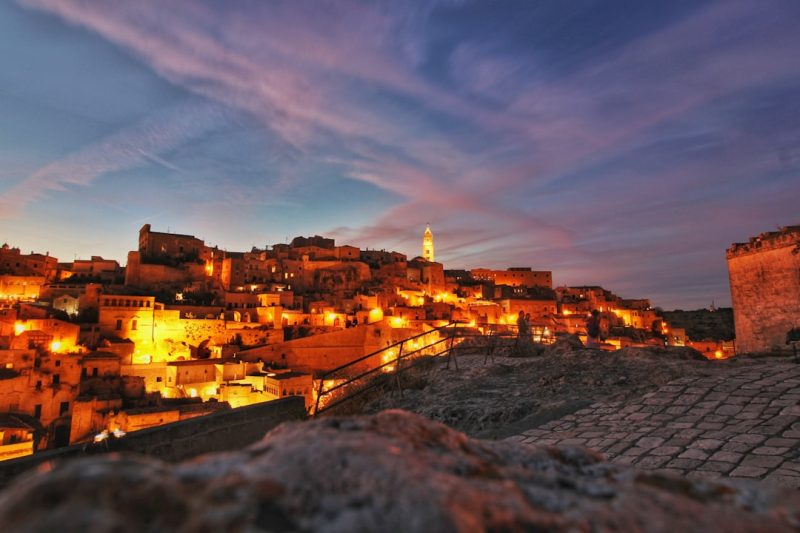
The artificial illumination of the Sassi uses a warm amber light that respects the colour of the stone rather than washing it out with the cold white of standard street lighting. The effect, visible from the viewpoints on the cliff edge above the Sasso Caveoso or from the road across the Gravina, is of a city that appears to have been carved from luminous stone: the surfaces catch the light and hold it, the cave openings become dark punctuations in the illuminated mass, and the whole scene reflects in the Gravina river at the bottom of the ravine in conditions of sufficient water.
Walking through the Sassi at night, on the stone paths and staircases that connect the various levels of the cave city, produces an experience that has no obvious equivalent in other Italian cities. The paths are quiet — the few hundred people now living in the Sassi are a small population for the extent of the district — and the darkness between the illuminated points is substantial. The sense of moving through a city that was built over two thousand years by a process of subtraction from the rock, rather than by construction above it, is at its most immediate at night, when the visual noise of the tourist economy (the restaurants, the signage, the information panels) retreats and the geology reasserts itself.
The viewpoint above the Sasso Caveoso, accessible from the Via Montescaglioso at the upper edge of the district, provides the classic nocturnal view of the Sassi: the illuminated cave city descending toward the ravine, the dark cut of the Gravina below, the lights of the Murgia caves visible on the opposite cliff. This view, in the hour after full dark in spring and autumn when the air is clear, is among the most dramatic nocturnal landscapes in Italy.

The Cave Churches at Dusk
The Byzantine cave churches of the Sassi are open during daylight hours and closed at night, but arriving at the most significant ones in the hour before closing allows for a visit in the late light that is different from the midday tourist experience. The Church of Santa Maria de Idris, carved into the isolated rock outcrop called the Pizzo that rises from the middle of the Sasso Caveoso, has a dramatic position and a sequence of Byzantine frescoes in the rock-cut interior. The Church of Santa Lucia alle Malve, in the Sasso Caveoso, contains some of the best-preserved frescoes in the district. Both are small, both have restricted opening hours, and both reward visiting without the groups that occupy them in the middle of the day.
The best approach to the Sassi for someone wanting to experience the nocturnal version of the city is to arrive in the late afternoon and walk the Sasso Barisano first — the more easily accessible district, with the main tourist infrastructure — then move through the Civita to the Sasso Caveoso as the light fails, and position yourself at one of the cliff-edge viewpoints for the transition from dusk to full dark. The illumination of the cave city is on a timer; the moment when it comes on, in the deepening dusk, is one of the better visual events that an Italian city offers.
The Murgia at Night
The Murgia Materana nature reserve on the opposite side of the Gravina gorge is accessible during daylight hours via a walking bridge at the bottom of the ravine. At night, the cave city of the Murgia — uninhabited, unilluminated, covered in cave openings that correspond to the inhabited Sassi across the gorge — is visible only as dark shapes against the sky from the Matera side. The effect of looking from the illuminated inhabited city toward the dark uninhabited mirror image across the gorge is one of the more unusual visual experiences the site offers. The Murgia caves are the older of the two — some date from the Paleolithic — and the scale of human habitation on both sides of the gorge, one now bright and one completely dark, gives the gorge landscape a temporal dimension that the individual cave churches, however impressive, do not provide alone.
The Food of Matera at Night
The restaurants of the Sassi and the old town function on an Italian evening rhythm: dinner typically begins around 19:30-20:00 and continues until late, and the combination of late dining with the nocturnal beauty of the Sassi visible from terraces and open windows makes Matera one of the Italian cities where evening restaurant dining is most embedded in the visual experience of the place.
The cuisine of the Materano is the cucina povera of Basilicata: bread (the famous Pane di Matera, a large loaf of durum wheat semolina with a characteristic C-shape, holds the protected designation of origin under Italian law), pasta (strascinati — a flat, rough-surfaced pasta dragged by hand across the board, typically dressed with a ragu or with turnip greens and chilli), lamb and pork preparations from the pastoral economy of the Murgia plateau, and the wild herbs — particularly the peperoni cruschi, the sweet dried paprika peppers of the Senise variety that appear in numerous Basilicatan preparations, fried until crisp and eaten as a garnish or a condiment.
The wine of the Aglianico del Vulture DOC, produced from Aglianico grapes grown on the volcanic soils around Barile and Rionero in Vulture to the northwest, is the natural accompaniment: a dark, tannic red with the capacity for significant ageing that is among the more serious wines of southern Italy. Eating a plate of strascinati with a glass of Aglianico del Vulture on a terrace above the Sasso Caveoso after dark is the specific synthesis of food, wine, and landscape that Matera offers to the visitor willing to stay the night rather than arriving and leaving with the day-trip buses.

Staying in the Sassi
Several hotels and guesthouses are now housed in former cave dwellings within the Sassi, offering the experience of sleeping in a rock-cut room that was occupied for centuries before being abandoned during the postwar relocations. The better establishments have invested in the preservation of the cave fabric while providing the contemporary amenities that modern visitors require; the results range from the genuinely exceptional (cave hotels that integrate the geological character of the space with design intelligence) to the merely themed.
The experience of waking in a cave room and walking out into the Sassi in the early morning — before the day visitors arrive, when the paths belong to the few residents and the stray cats that have made the district their own — is one of the specific pleasures of Matera that cannot be accessed from a day visit. The quality of the light on the stone in the first hour after sunrise, the silence of the cave city in the hour before the tourist infrastructure opens, and the particular atmosphere of a place that was lived in continuously for millennia and is now being lived in again after a period of forced absence: these things belong to the Matera that exists before the tour buses arrive.
Getting to Matera
Matera is one of the more difficult major Italian cultural destinations to reach by public transport. The city has no train station on the national rail network; the closest mainline stations are Bari (approximately 65 km, 1.5 hours by bus or car) and Taranto (approximately 70 km). A private rail connection between Bari and Matera — the Ferrovie Appulo Lucane — runs infrequently and slowly. For visitors without a car, the bus connection from Bari is the most practical option.
By car from Rome, the journey is approximately 4.5 hours via the A1 south to Salerno and then east across the Basilicata interior. From Naples, the journey through the Basilicata mountains is approximately 3 hours. The drive through Basilicata, particularly the section across the Murgia plateau approaching Matera from the northwest, provides the landscape context for the Sassi: the vast, dry, ancient plateau, dissected by deep river gorges, is the geological matrix from which the cave city was carved, and arriving across it by road is a better preparation for understanding the Sassi than arriving from the Bari direction, which lacks the same spatial drama.