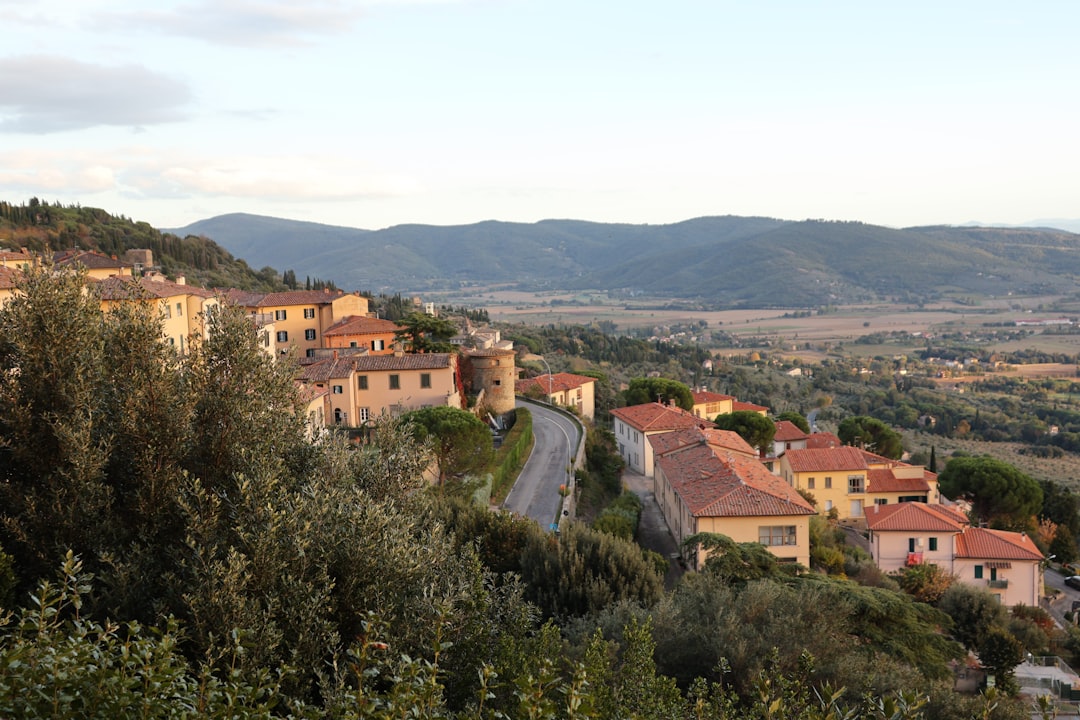
The views from Cortona are among the best in Tuscany, which is a competitive field. The town sits at 600 metres above sea level on the southern slope of the Alpe di Poti, looking out over the wide flat floor of the Val di Chiana — the agricultural valley that runs from Arezzo south toward Lake Trasimeno and the Umbrian border. On clear days, the view extends to Montepulciano on its hill to the southwest, to Trasimeno glinting to the southeast, and, if the air is clean after rain, to the Apennines on the northern horizon. The view from the Fortezza Medicea at the top of the town, above the inhabited part of the old city, is broader still — 360 degrees of Tuscany and Umbria laid out with the Val di Chiana as the centre.
Cortona’s origins are Etruscan. The Etruscan city occupied the same hilltop that the medieval and modern town occupies, and the relationship between the two layers of settlement is physically present in the walls. Sections of the Etruscan perimeter wall — dry-stone construction in large irregular blocks, without mortar — survive beneath and alongside the medieval city walls. The oldest sections date from the fifth or fourth century BC. The combination, visible from the road that circles the lower edge of the town, is unusual: you can see exactly where the Etruscan stone ends and the medieval masonry begins.

The Museo dell’Accademia Etrusca
The Museo dell’Accademia Etrusca e della Citta di Cortona, housed in the Palazzo Casali on the Piazza della Repubblica, is the best reason to visit Cortona beyond the architecture and the views. The Etruscan collection includes bronzes, pottery, and metalwork of high quality recovered from the tombs that surround the town — the Melone del Sodo and the Tanella di Pitagora are the most significant surviving tomb structures, both outside the town and both visitable.
The museum’s centrepiece is a large bronze lamp from the fifth century BC — an extraordinary object that combines functional design with decorative ambition that makes it resemble something from a much later period. Sixty centimetres in diameter, covered with twenty-six oil lamps and decorated with figures and masks around the rim, it is the finest surviving example of Etruscan decorative bronze work in Italy. The Egyptian collection, assembled by a member of Napoleon’s Egyptian campaign, is unexpected and good.

The Medieval Town
The Piazza della Repubblica, with its medieval Palazzo Comunale, is the social centre of Cortona. The Saturday market extends across the piazza and the surrounding streets with a range of local produce — the Val di Chiana is excellent agricultural land — and non-food goods typical of Tuscan markets. The Piazza Signorelli, adjacent, is named for Luca Signorelli, the painter born in Cortona who worked across central Italy in the late fifteenth and early sixteenth centuries and whose most important surviving works are in the Cathedral of Orvieto.
The Diocesan Museum, across from the Cathedral of Santa Maria Assunta, contains two exceptional paintings: Fra Angelico’s Annunciation, made for Cortona’s Dominicans, and Pietro Lorenzini’s polyptych. The Fra Angelico is one of the earlier versions of a composition the artist returned to repeatedly; the Cortona version is calmer and more resolved than the more famous version in Florence’s Museo di San Marco.
Lake Trasimeno and the Surrounding Area
Cortona is twenty minutes by car from Lake Trasimeno — the largest lake in peninsular Italy, a wide, shallow body of water that crosses the Tuscany-Umbria border and is surrounded by olive groves and hilltop towns. The Trasimeno lakeshore was the site of the battle of 217 BC in which Hannibal’s Carthaginian army ambushed and destroyed a Roman consular army — the bones of soldiers found in the area during agricultural work in the twentieth century confirmed the ancient accounts.
Castiglion Fiorentino, fifteen kilometres north, and Lucignano, twenty kilometres northwest, are small towns in the Arezzo province that are regularly overlooked in favour of the more famous Val d’Orcia names. Both have medieval centres of genuine quality. Lucignano in particular has an unusual urban plan — a series of concentric elliptical streets inside the town walls — that reflects medieval Italian planning considerations that are not well understood but are immediately visible from a walk through the town.
Cortona fills from June through August — it has been on the anglophone tourist circuit since a widely-read memoir of the late 1990s, and the summer crowds confirm it. The pace changes in September. The chestnut and truffle season arrives in the surrounding hills, the Val di Chiana clears, and the afternoon light across the valley in October has a quality the summer haze never allows. The museum requires no advance booking. The piazza has room in it again. In most practical respects, Cortona is better then than it is in August.
Photo: Meg von Haartman on Unsplash