The Borgo Hotel as Proposition
The borgo — the Italian word for a small fortified village, the nucleated settlement behind its walls that constitutes one of the most characteristic forms of Italian urbanism — has been the object of a hospitality proposition for long enough that the proposition has become a genre. The borgo hotel: an entire medieval village converted to accommodation use, its houses now guest rooms, its streets now corridors, its piazza now the breakfast terrace. The formula has been applied across central Italy with variable results, and the Marche interior has become one of its most significant territories, partly because the region contains an unusually high density of fortified villages whose populations have declined to the point where conversion is economically feasible, and partly because the Marche landscape offers the combination of landscape beauty, historical depth, and tourist unsaturation that the genre requires.
The borgo hotel in the Marche is not a uniform product, and the differences between the best and the worst examples are considerable. The best share a relationship to the village fabric that the conversion has respected rather than overwritten: the spatial logic of the medieval street, the proportions of the room that was a house rather than a hotel room, the view from a window that was originally a window in someone’s life rather than in someone’s itinerary. The worst share the opposite: the medieval container filled with the standard contents of the international hotel market, the stone walls and the terracotta floors providing the stage set for an experience that could be happening anywhere.
The Marche Interior

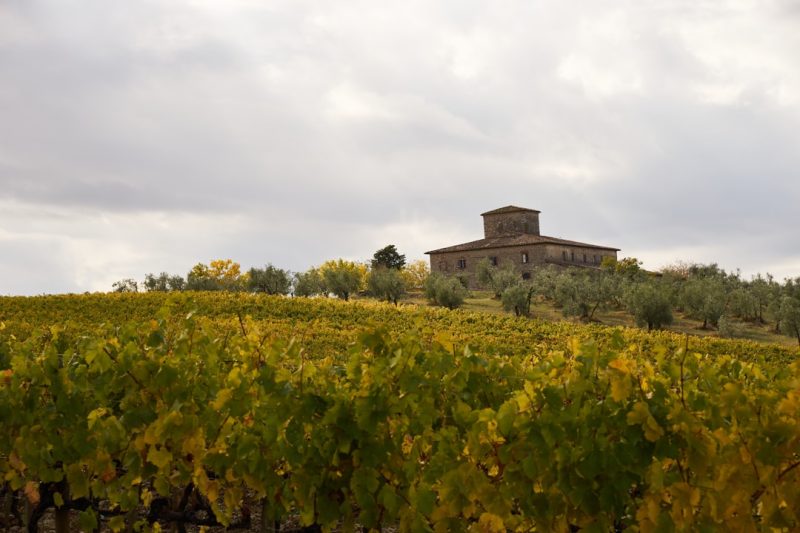
The landscape of the Marche interior is the landscape of the sub-Apennine ridge system: a series of parallel ranges running northeast to southwest, each topped by a fortified village or a medieval tower, each valley between them cultivated in the mixed pattern of grain, vine, and olive that the geography has always required. The visual character is one of successive planes: the ridge you are on, the valley below it, the ridge beyond, and above everything the line of the Apennine crest that marks the boundary with Umbria and Lazio. In good light — the clean air after rain, the late afternoon when the sun is at a low angle — the succession of planes resolves into something that the local painters of the fifteenth century reproduced in their background landscapes: not idealised but observed, with the specific proportions of the Marche hills rather than the Tuscan or Umbrian ones.
The fortified villages that crown these ridges — and there are hundreds of them, at intervals of a few kilometres along each ridge — were built between the eleventh and the fifteenth centuries in response to the specific security conditions of the Marche: a territory contested between papal, imperial, and local seigneurial powers, whose population had learned to build on high ground and behind walls as a matter of survival rather than aesthetics. The walls that make these villages so visually compelling from a distance were built by people who were not primarily interested in being visually compelling from a distance.
The Architecture of the Borgo
The internal architecture of the Marche borgo is not the architecture of public display. The houses are modest, their facades unmarked by the architectural ambition that would have produced the elaborate portals and corner pilasters of the urban palazzo. They are houses of farmers and artisans, built to the standard of solid construction rather than conspicuous consumption, and their quality is in the structural intelligence of the masonry — the way the walls distribute the load of the roof, the way the window proportions allow in light without admitting cold, the way the ground floor is elevated above the street by a step that keeps the damp from entering — rather than in any decorative programme.
The conversion of these houses to guest rooms requires decisions that reveal the philosophy of the conversion: does the room retain the proportions and materials of the original house, or does it impose the proportions and materials of the standard hotel room? The answer, visible in the photographs of any borgo hotel website, is the most reliable indicator of the quality of the experience the property provides.
The Social Life of the Surviving Borgo
Not all of the Marche borghi have been converted to hospitality use, and the ones that have not — the villages that retain small but functioning populations, that still have a bar and a church and a weekly market and a group of elderly residents who have been there since the war — are the ones that most fully justify the idea of the borgo as a human achievement rather than an architectural one. Spending time in one of these surviving communities — not as a guest in a converted property but as a visitor staying in a rented house, or in a small family-run hotel at the village edge, and participating in the daily life of the place at whatever level is possible for an outsider — is an experience that the borgo hotel, for all its quality, cannot replicate.
The difficulty is that the surviving borgo with a functioning social life is also the borgo with the least tourist infrastructure: the bar may not serve food, the accommodation may be limited to a single agriturismo on the road below the village, the evening may offer nothing more than the passeggiata along the main street and the conversation of whoever is sitting outside the bar. This is not a deficiency in the entertainment programme; it is the programme. The cultural density of this landscape — the frescoed churches and private chapels that the Marche hill towns contain in disproportion to their size — is part of the same inheritance; the Renaissance fresco tradition of the Marche interior is the art-historical argument for lingering here rather than passing through.
Selected Territories
The Marche borghi that have been most successfully adapted to hospitality use without losing their character tend to be in the central and southern sections of the region: the Montefeltro hills in the north are too closely associated with Urbino’s Renaissance heritage to escape the gravitational pull of that city’s tourism; the coastal strips are too developed to provide the isolation that the borgo experience requires. The area between Macerata, Camerino, and the Sibillini mountains to the south offers the density of fortified villages and the absence of mass tourism that the proposition requires.
The earthquake of 2016, which devastated a significant portion of this territory, has complicated the picture: several of the most historically significant borghi of the Macerata and Camerino hinterland are still in various stages of reconstruction, their populations displaced and their tourism infrastructure interrupted. The recovery is underway and, in some cases, generating the kind of careful rebuilding that takes the opportunity of reconstruction to restore rather than merely replace. The visitor who comes to this territory now is coming to a landscape in the process of recovering from a trauma, and that process is, in its own way, part of the story that the territory tells. The most practical way to reach several of the more remote hill towns is by regional train to Macerata or Camerino and onward by local bus — the infrastructure is slower than driving but places the arrival in the context of how the territory actually functions.
What the Borgo Gives
The borgo hotel at its best gives something that the resort hotel cannot provide: a specific location, in a specific landscape, with a specific history, in which the guest is not merely consuming a product but inhabiting a place. The place has existed, in the form in which you are encountering it, for eight hundred years; it will continue to exist after your departure in a form that your presence will not significantly alter. This quality — the sense that the place is not primarily for you, that it has its own purposes and its own story of which your visit is a small and temporary chapter — is what the best borgo hotels convey and what the worst ones, in their eagerness to provide the experience their guests expect, inadvertently destroy.