The Network Beneath the Network
The high-speed rail network that has transformed Italian domestic travel in the past two decades is a remarkable achievement: the Frecciarossa services that connect Milan, Florence, Rome, and Naples at speeds approaching 300 kilometres per hour have made the principal Italian cities more accessible to each other than they have been at any point in history. They have also, in the logic of infrastructural investment, concentrated the benefits of connectivity on the places that were already connected and made the places that were not connected feel, by contrast, more remote.
The regional rail network — the intercity and regionale services that connect the smaller cities, the provincial towns, the agricultural and industrial centres that do not appear on the high-speed map — is the infrastructure that the infrastructure narrative tends to leave out. It is slower, less comfortable, and less reliably punctual than the high-speed services. It is also the network that connects the places most worth reaching on Italian territory, if what you are looking for is not the principal cities but the country behind them.
The Regional Train as Cultural Instrument

The experience of travelling by regional train in Italy is an experience of the country in a register that the high-speed train, for all its efficiency, cannot provide. The high-speed train connects cities; the regional train connects communities. Its passengers are people going about the ordinary business of Italian provincial life: the student commuting from the hill town to the university city, the agricultural worker whose field is at a stop that no taxi would serve, the elderly woman whose destination is the market town that has been her nearest significant service centre for sixty years. The train is not a tourist vehicle; it is a public utility, and the experience of using it as such — of being a passenger among passengers rather than a traveller among travellers — gives access to a social texture that the tourist infrastructure is not designed to provide.
This is an observation about information as much as it is about travel. What you learn about a place by moving through it in the company of the people who live there is different from what you learn by arriving at it in the company of people who are visiting it. The regional train, in this sense, is a research tool as much as a transport vehicle.
The Lines Worth Taking
Several regional rail lines in Italy are, by any objective assessment, among the most beautiful train journeys in Europe. The Ferrovia Circumetnea — the narrow-gauge line that encircles Mount Etna, connecting Catania to the agricultural communities on the volcano’s flanks — is one; the Transiberiana d’Italia, which crosses the Apennine backbone between Sulmona — gateway to the Abruzzo plateau festival calendar — and Isernia on a route built in the early twentieth century and barely modified since, is another. The Palermo-Agrigento line crosses the Sicilian interior in conditions that give the passenger the impression of seeing a landscape preserved, by some administrative oversight, in something approaching its nineteenth-century state.
None of these lines is fast. The Transiberiana d’Italia covers 128 kilometres in approximately five hours — a speed that a bicycle would not significantly underperform. But the journey is not about the destination; it is about what is visible from the window at the pace the train provides, and what is visible — the viaducts of the Majella range, the snowfields that persist on the Abruzzo uplands into late spring, the abandoned stations of villages that emptied in the 1950s and 1960s and whose platforms have not seen a regular service in thirty years — is a landscape that speed would make invisible.
The Practical Architecture of the Regional Journey
Travelling by regional train in Italy requires a degree of flexibility that the high-speed network does not demand and that the visitor accustomed to the managed certainty of the Frecciarossa experience may find initially disorienting. The regional service may run late; it may be replaced by a bus on certain days; the connection at the junction station may be tighter than the timetable suggests. These are not reasons to avoid the regional train; they are conditions that the regional journey imposes, and that the journey becomes richer for accepting.
The ticketing system for regional trains is significantly cheaper than the high-speed network — a four-hour regional journey typically costs less than a twenty-minute taxi to the high-speed station — and it is the ticketing system most forgiving of spontaneous decisions. The regional ticket can typically be purchased at the station, on the day, without the advance booking that the high-speed network increasingly requires for its better prices. This flexibility makes the regional network the natural infrastructure for a journey that is being invented as it proceeds rather than booked six weeks in advance.
Stations as Architecture
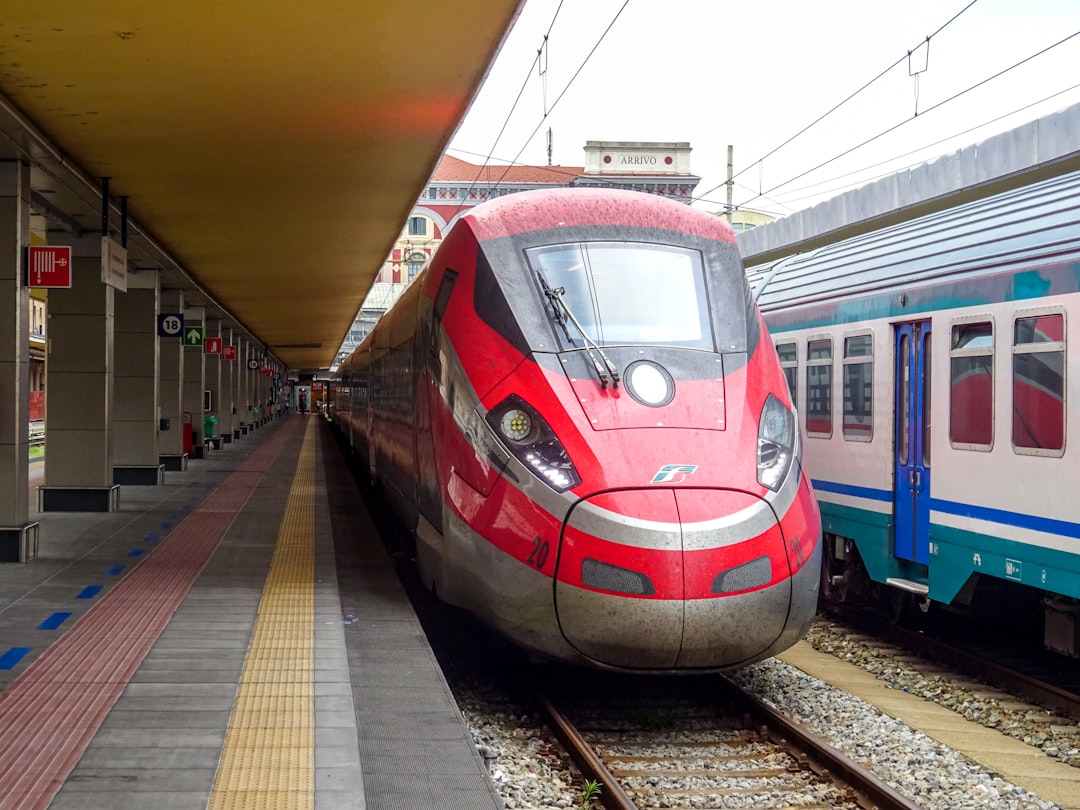
The stations of the Italian regional network are themselves a chapter in the architectural history of the country. The small station buildings designed by the Ferrovie dello Stato in the early twentieth century — functional, modest, with the rationalist vocabulary that Italian state architecture in the 1930s applied to everything from post offices to border crossings — are one of the more consistent design achievements of the Italian built environment. They are also, in many cases, in a state of picturesque disrepair: the paint fading, the waiting room closed, the bar that served the station community for decades reduced to a vending machine or simply absent.
The station at a small Italian town tells you a great deal about the town’s economic history: the stations that are well-maintained and staffed are the towns whose regional role has persisted or expanded; the stations that are unmanned, with their waiting rooms locked and their departure boards dark, are the towns from which the economic activity has departed. Arriving at such a station — stepping off the regional train onto a platform that is cracking through the concrete, in a town whose main employer closed twenty years ago — is an encounter with a dimension of Italian economic history that the country’s tourism infrastructure has a strong interest in not showing you.
A Different Map of Italy
The Italian regional train network, read carefully, produces a different map of the country from the one that tourism constructs. The places accessible by regional train — the towns that appear as stops rather than as destinations, the junction cities whose importance is infrastructural rather than cultural, the termini of branch lines that once served industries now closed — are a map of the country’s economic geography rather than its aesthetic one. Following that map rather than the tourist one produces a journey that is, in the most literal sense, off the established itinerary.
The traveller who builds a fortnight in Italy around the regional train network rather than around the high-speed connections will see a country that is largely invisible to the itinerary that moves between Florence, Venice, Rome, and Amalfi. That country includes the Valle d’Itria, accessible from Bari and Taranto, the Ligurian villages of the Cinque Terre, and the Abruzzo plateau communities that organised the summer festivals described in this magazine. This country is not consistently beautiful or consistently interesting; it is the country in its working state, with its complications and its depletions and its local prides intact. The regional train is the instrument for accessing it, at the pace and in the company that it deserves.