Nduja has become ubiquitous beyond anything its origins in Spilinga would predict — a spreadable Calabrian salume now appearing in London pizza restaurants and New York pasta bars and on charcuterie boards in cities whose diners have never encountered the original. Most of those presentations omit where it comes from and why it tastes the way it does. The answer begins in Spilinga, a small municipality in the Vibo Valentia province of southern Calabria, on a stretch of Tyrrhenian coast that has historically had very little apart from pork, chillies, and the knowledge of how to combine them.
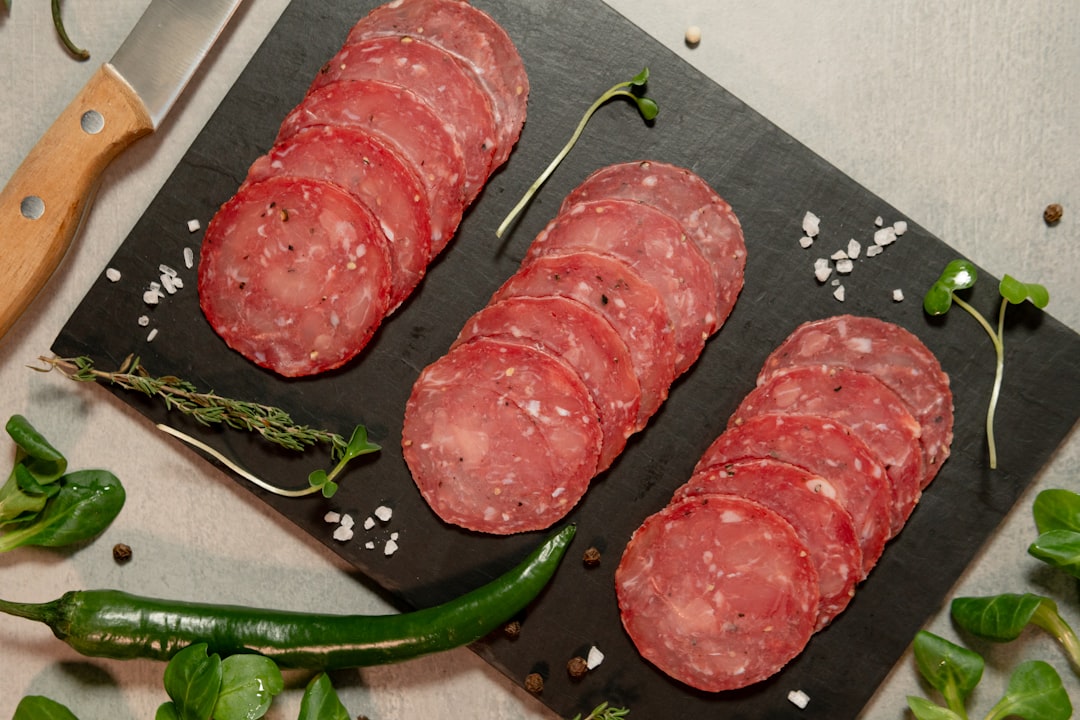
Nduja — pronounced roughly en-DOO-ya, with the stress on the second syllable — is a soft, spreadable salume made from a mixture of pork fat, tripe, and other secondary cuts blended with a high proportion of peperoncino piccante, the small, intensely hot chilli that grows throughout Calabria. The mixture is stuffed into a natural casing, smoked lightly, and cured for a period that can range from a few weeks to several months. The result is a product so red it borders on alarming, with a fat content high enough to make it pliable at room temperature and a heat level that lingers long after the mouthful is finished.
The Role of the Chilli
Calabrian peperoncino is not incidental to nduja — it is the structural argument. The chilli serves three functions simultaneously: it provides flavour (complex, fruity, with a slow-building heat rather than an immediate blast), it acts as a preservative (capsaicin inhibits bacterial growth, critical in a warm climate before refrigeration), and it gives the product its particular texture by interacting with the fat during curing. Producers in Spilinga are specific about which chillies they use. The local cultivar, smaller and more intensely flavoured than the more commonly grown varieties further north in Calabria, is dried and ground before being worked into the pork mixture.
The proportion of chilli to pork varies by producer and by tradition, but a serious nduja from Spilinga will contain enough peperoncino that the casing is entirely reddened through, not just on the surface. When sliced or spread, the interior should be uniformly red, deeply aromatic, and oily in the specific way that cured fat becomes when it has had time to transform.
Geography and Poverty as Ingredients
Nduja, like many of southern Italy’s most distinctive food products, was not designed to be a luxury item. It was designed to use what was available. In the sharecropping economy that characterised Calabria through much of the nineteenth and early twentieth centuries, families who raised pigs for their landlords were entitled to the parts of the animal that the landlord did not want: the organs, the fatty offcuts, the tripe. Combined with the chillies that could be grown on marginal land with minimal inputs, these secondary cuts became a product of considerable practical value — calorie-dense, self-preserving, and capable of providing flavour to dishes built around cheaper carbohydrates like bread and polenta.
The geography of Spilinga reinforced this dynamic. The town sits in hilly terrain without the agricultural advantages of the Sila plateau or the Piana di Sibari. What it had was a chilli-growing tradition concentrated enough that it became a specific regional identity. By the mid-twentieth century, nduja from Spilinga was being distinguished from similar products made elsewhere in Calabria — the particular combination of fat content, chilli variety, and smoking technique producing something that was recognisably its own thing.
Production: What the Standard Requires
Nduja di Spilinga currently holds IGP status — Indicazione Geografica Protetta — which defines the production area (the municipality of Spilinga and adjacent territory), the permitted cuts (soft fat from the jowl, belly, and shoulder, plus organ meats), the chilli requirement (minimum 30% by weight, sourced from the Vibo Valentia area), and the curing parameters. The smoking step, carried out over wood from local trees, is brief — more a flavouring than a preservation technique — and is followed by an air-curing period that allows the casing to firm while the interior remains soft.
The final product should spread without resistance when at room temperature. If it requires cutting or crumbling, it has either been produced incorrectly or stored too cold. This spreadability is the defining characteristic — the feature that makes nduja categorically different from other spiced salami, including the many Calabrian variants made with similar ingredients but a firmer texture designed for slicing.
How It Is Used
In Spilinga and the surrounding area, nduja is primarily eaten spread on bread — a slice of the dense, chewy pane calabrese with a thick layer of nduja applied cold, so the fat begins to soften against the bread without becoming liquid. Alongside this, it works through local cooking: into pasta sauces as a base, into bread rolls for feast days, into the legume soups where its fat enriches the broth and its chilli provides the heat.
What nduja does in cooking is different from what most spicy ingredients do. Because of its fat content, it dissolves into sauces rather than remaining as distinct pieces, distributing both heat and richness throughout the dish. A small amount — a tablespoon worked into a pan of tomatoes and garlic — will colour and season an entire portion of pasta in a way that dried chilli flakes cannot replicate. This is partly why it travelled so effectively beyond Calabria: it behaves like both a spice and a fat, solving two problems at once.
The Export Problem
The international success of nduja has created the predictable problem: a product that can be made anywhere is now being made everywhere. Versions produced in industrial facilities in northern Italy, in Germany, in the United States, and elsewhere share a name with the original but differ significantly in the quality of the pork, the variety and proportion of the chilli, and the curing process. Some are not smoked at all. Some use a standardised commercial chilli powder with none of the flavour complexity of the Calabrian cultivar. Most are considerably milder, calibrated to an international palate that has not encountered the original.
The IGP designation provides legal protection for the Spilinga version within the European Union, but it does not prevent the use of the name “nduja” for products made outside the designated area in markets without equivalent protections. For anyone buying nduja outside Italy, the safest indicator of quality is the provenance label — products that explicitly state Spilinga or Vibo Valentia on the packaging are subject to the production standard; everything else is a different product using the same name.
Finding It
In Spilinga itself, several small producers sell directly, and the market days in the surrounding comuni will typically have at least one stall where the real product is available in different ages and fat ratios. The annual Sagra della Nduja, held in Spilinga in August, brings together producers from across the municipality and is the most concentrated point for tasting and buying. For those travelling through Calabria more broadly, serious salumerie in Catanzaro, Vibo Valentia, and Reggio Calabria carry Spilinga-provenance nduja alongside the region’s other cured meats.
Nduja travels well. The fat content that makes it so effective as an ingredient also acts as a preservative, meaning it can be transported without refrigeration for short periods and kept refrigerated for months without deterioration. A well-sealed piece, bought directly from a producer in Spilinga, will arrive home intact and will continue to develop flavour for weeks after purchase. It is, in this respect, almost the ideal souvenir — compact, useful, and unmistakably from the specific place where it was made.